
Six-station vacuum degassing machine
The Six-station Vacuum Degassing Machine is a high-efficiency system designed for the simultaneous evacuation and air-removal of multiple heat pipes or vapor chambers. In the phase-change cooling industry, the presence of even trace amounts of Non-Condensable Gases (NCG) can cripple thermal performance. This machine utilizes a parallel manifold system and high-performance vacuum pumps to achieve deep vacuum levels across six units at once. By integrating controlled heating with vacuum suction, it “boils off” absorbed gases and moisture from the internal wick and the working fluid, ensuring a pure vacuum environment for maximum heat transfer efficiency.
Key Features
- 6-Station Parallel Processing: Independent vacuum ports allow for the simultaneous processing of six units, significantly reducing the bottleneck in mass production.
- Ultra-High Vacuum Capability: Equipped with a dual-stage rotary vane pump and optional diffusion/turbo pump to reach vacuum levels as low as 10−310−3 to 10−510−5 Pa.
- Integrated Degassing Heating: Features independent heating elements for each station to accelerate the release of trapped gases from the sintered wick and pipe walls.
- Precision Vacuum Monitoring: High-resolution Pirani or Penning gauges provide real-time, independent vacuum readings for each station via the digital HMI.
- Automatic Leak Detection: The system software includes a “Vacuum Rise” test mode to automatically identify and flag any leaky pipes before they proceed to the welding stage.
- Contamination-Free Manifold: Constructed from electro-polished 316L stainless steel with high-vacuum KF/CF fittings to prevent outgassing and ensure a clean process.
Technical Parameters
| Item | Specification Detail |
|---|---|
| Model | CT-HP-VD6 Series |
| Number of Stations | 6 Independent Ports |
| Ultimate Vacuum | ≤5×10⁻³≤5×10⁻³ Pa (Standard Configuration) |
| Vacuum Pump Set | Dual-Stage Rotary Vane + Diffusion/Turbo Pump |
| Degassing Temp. | Ambient to 150∘C150∘C (PID Controlled) |
| Temp. Accuracy | ±1.0∘C±1.0∘C |
| Vacuum Gauge Range | 1.0×10⁵∼1.0×10−51.0×105∼1.0×10⁻⁵ Pa |
| Control System | Siemens/Mitsubishi PLC + 10″ Color Touchscreen |
| Manifold Material | SUS 316L (High-Vacuum Polished) |
| Power Supply | AC 380V, 3-Phase, 50/60Hz |
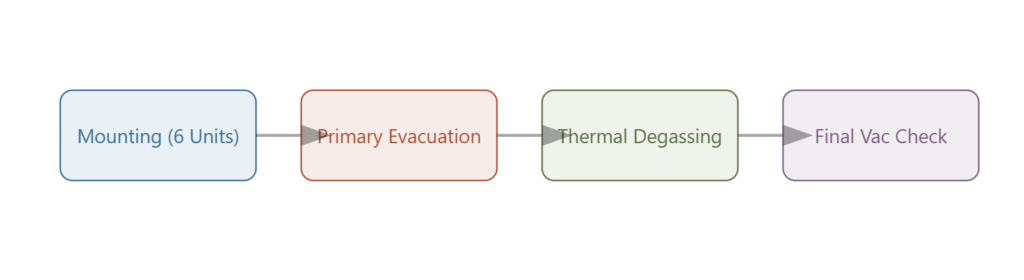
Workflow Diagram
Applications
- Premium Computing Cooling: Degassing heat pipes for workstations and AI servers.
- Vapor Chamber (VC) Production: Deep vacuuming for high-performance VC baseplates.
- Medical & Scientific: Fabricating ultra-pure thermal links for lab equipment.
- Space & Defense: Small-batch production of aerospace-grade heat pipes.
FAQ
Q1: What are "Non-Condensable Gases" (NCG) and why must they be removed?
A: NCGs are gases like air or CO2 that do not condense back into liquid during the heat pipe cycle. They collect at the condenser end, creating a “dead zone” that blocks vapor flow and increases thermal resistance. Our machine uses high vacuum and heat to ensure these gases are 100% removed.
Q2: Why choose a 6-station machine instead of a single-station unit?
A: Deep vacuuming is a time-consuming process (often taking several minutes to an hour depending on the pipe size). A 6-station unit allows you to process 6 units in the same time it would take for one, drastically improving your factory’s ROI and daily output.
Q3: Can each station be controlled independently?
A: Yes. Our system features independent valves and sensors for each port. If one pipe has a massive leak, you can isolate that station without affecting the vacuum levels of the other five pipes.
Q4: Does the machine include a heating function?
A: Yes. We include isothermal heating jackets for the pipes. Heating the pipes while vacuuming helps “shake off” gas molecules attached to the copper walls and the sintered wick, achieving a much “harder” (purer) vacuum.
Q5: What maintenance does the vacuum system require?
A: The primary maintenance is checking and changing the vacuum pump oil. If the oil becomes contaminated with moisture from the pipes, the ultimate vacuum level will drop. We recommend a monthly oil inspection for high-volume production.