
Heat Pipe Necking Machine
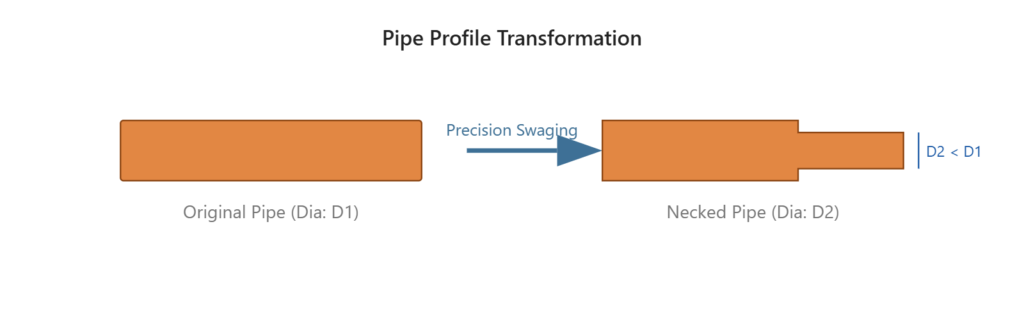
The Heat Pipe Necking Machine is a precision forming station used to reduce the diameter of one or both ends of a heat pipe. This process, known as “necking” or “swaging,” is a critical preparatory step before the degassing and welding phases. By shrinking the pipe end to a specific diameter with high concentricity, the machine ensures a perfect fit for the sealing dies and welding electrodes, significantly improving the yield rate of the final hermetic seal. Designed for high-speed production, it maintains the integrity of the internal wick structure while providing a smooth, scratch-free external finish.
Key Features
- High Concentricity Forming: Utilizes a multi-die rotary or hydraulic swaging system to ensure the necked section is perfectly centered, which is vital for automated welding.
- Adjustable Necking Length & Diameter: Precision-engineered dies can be swapped or adjusted to handle different shrinking ratios and neck lengths (e.g., shrinking a ϕ8mmϕ8mm pipe down to ϕ3mmϕ3mm).
- Surface Protection Technology: Polished tungsten carbide or high-speed steel (HSS) dies prevent scratching or “galling” of the copper surface, maintaining the aesthetic and functional quality of the pipe.
- Dual-Stage Precision: Features a pre-clamping mechanism and a secondary forming stroke to prevent pipe deformation or internal wick collapse during the shrinking process.
- High-Speed Cycle: Optimized for mass production with a cycle time of less than 3 seconds per pipe, compatible with automatic bowl feeders or robotic arm integration.
- Compact & Low Noise: Engineered with a vibration-damping frame and precision bearings to reduce noise levels in the factory environment.
Technical Parameters
| Item | Specification Detail |
|---|---|
| Model | CT-HP-NK Series |
| Processing Range | Pipe Diameter: ϕ2mm∼ϕ16mmϕ2mm∼ϕ16mm |
| Necking Length | 5mm∼50mm5mm∼50mm (Adjustable) |
| Diameter Accuracy | ±0.02mm±0.02mm |
| Concentricity | ≤0.05mm≤0.05mm |
| Cycle Time | 2.5∼42.5∼4 seconds per piece |
| Drive System | Hydraulic or High-Precision Servo-Electric |
| Die Material | Tungsten Carbide / SKD-11 High-Grade Steel |
| Control System | PLC Control with Foot Switch or Auto-Trigger |
| Power Supply | AC 380V, 3-Phase, 50/60Hz |
Workflow Diagram
Applications
- Standard Heat Pipes: Preparing round pipes for TIG welding.
- Vapor Chamber Tubes: Shrinking the filling stem of VCs for ultrasonic sealing.
- Complex Assemblies: Necking pipes to fit into specific heatsink fin stacks or baseplate holes.
- Custom Fittings: Creating stepped pipe diameters for specialized liquid cooling connectors.
FAQ
Q1: Why is necking necessary instead of just welding the original pipe diameter?
A: Necking reduces the “gap” that the weld or seal needs to close. A smaller diameter at the tip requires less energy to fuse, creates a much stronger vacuum-tight seal, and ensures the heat pipe fits into standardized degassing ports on the filling machine.
Q2: Does the necking process damage the internal wick (sintered powder or mesh)?
A: Our machines use a “Soft-Touch” incremental forming technique. By controlling the shrinking speed and using precision dies, the copper wall is compressed without causing the internal wick structure to detach or collapse, maintaining the pipe’s capillary performance.
Q3: Can one machine handle different pipe diameters?
A: Yes. The machine is designed for Quick Die Changeovers. You can switch from a 6mm setup to an 8mm setup in less than 10 minutes. We provide custom die sets for all standard and non-standard metric/imperial sizes.
Q4: How do you prevent the pipe from bending during the necking stroke?
A: The machine includes a V-block alignment guide and a pneumatic tail-stock gripper. This keeps the entire length of the pipe perfectly horizontal and stable while the front-end die performs the shrinking operation.
Q5: Is lubrication required during the necking process?
A: For most copper pipes, a very light mist of volatile vanishing oil is used. This reduces friction in the die and ensures a mirror-like surface finish. The oil evaporates quickly and does not interfere with the subsequent welding process.