
Multi-station Thermal Performance Tester
The Heat Pipe Multi-station Thermal Performance Tester is a high-precision automated system designed for the simultaneous measurement of the thermal resistance (RthRth) and maximum heat transfer capacity (QmaxQmax) of multiple heat pipes or vapor chambers. It simulates the actual heat source and heat sink conditions of end-use applications (such as CPUs or power electronics). By monitoring the temperature gradient across the pipe under controlled power loads, the system provides a comprehensive evaluation of the heat pipe’s internal efficiency, wick health, and vacuum quality.
Key Features
- High-Throughput Parallel Testing: Available in 4, 8, or 10-station configurations, allowing for independent testing of multiple samples under the same or different power loads.
- Precision PID Load Control: Each station is equipped with an independent DC power supply and PID controller to maintain a stable heat flux, with power accuracy up to ±0.1W±0.1W.
- Automated Thermal Resistance Calculation: The software automatically calculates Rth=(Te−Tc)/QRth=(Te−Tc)/Q, where TeTe is the evaporator temperature and TcTc is the condenser temperature.
- Multi-Angle Reliability Mapping: The system features a motorized tilting mechanism (0∘0∘ to ±90∘±90∘) to test the heat pipe in gravity-assisted or anti-gravity orientations.
- High-Speed Data Acquisition: Real-time monitoring of all thermocouples with data logging at 1-second intervals, providing a detailed thermal stability profile.
- Modular Clamping Interface: Interchangeable copper blocks (Heating/Cooling) allow for a wide range of product shapes, including round pipes, flattened pipes, and Vapor Chambers.
Technical Parameters
| Item | Specification Detail |
|---|---|
| Model | CT-HP-TPT Series |
| Test Stations | 4 / 8 / 10 / 12 Stations (Standard & Customizable) |
| Heating Power | 0 – 500W per station (Customizable for server-grade pipes) |
| Cooling Method | Liquid-cooled (Water Chiller) / Forced Air-cooled |
| Temperature Accuracy | ±0.1∘C±0.1∘C (Type T/K Thermocouples) |
| Power Stability | ≤0.5%≤0.5% |
| Tilting Range | 0∘∼±90∘0∘∼±90∘ (Motorized / Automatic) |
| Cycle Time | 2∼52∼5 minutes (depending on stabilization time) |
| Software | LabVIEW-based or Proprietary Windows Suite |
| Safety Features | Over-temp Alarms, Liquid Leakage Detection, E-Stop |
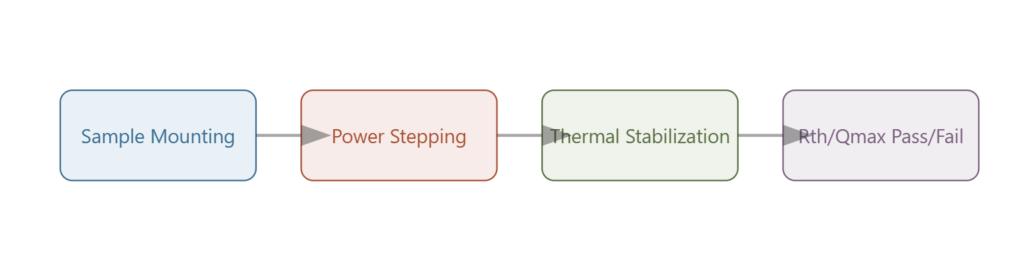
Workflow Diagram
Applications
- Consumer Electronics: Mass production testing for laptop, tablet, and smartphone heat pipes.
- Computing & AI: High-power thermal validation for server heat sinks and GPU cooling modules.
- Automotive Electronics: Testing heat pipes for LED headlamps and battery management systems.
- Renewable Energy: Thermal performance audit for inverter and power module heat pipes.
FAQ
Q1: What is the difference between
A: RthRth (Thermal Resistance) measures how efficiently the heat pipe transfers heat at a standard load. QmaxQmax (Maximum Heat Transfer) measures the limit at which the heat pipe fails (dries out). Our tester performs both measurements in a single automated sequence.
Q2: How does the system handle "Anti-Gravity" testing?
A: Heat pipes rely on a capillary wick to return liquid. In anti-gravity mode (evaporator above the condenser), the wick must work against gravity. Our motorized tilt system allows you to accurately measure the power drop-off at various angles to ensure performance in any device orientation.
Q3: Is the system compatible with different sizes of heat pipes?
A: Yes. The machine uses a Universal Clamping Base. You only need to change the copper heating and cooling blocks (which are precision-machined to fit your specific pipe diameter) to switch between different product models.
Q4: Can the test results be automatically uploaded to my factory's MES?
A: Absolutely. Our system supports Industry 4.0 data integration. Test results, including serial numbers (via scanner), date, QmaxQmax values, and pass/fail status, can be exported in CSV/JSON format or directly linked to your server via SQL database or local network.
Q5: What is the benefit of the "Multi-station" approach versus a single-station tester?
A: Thermal testing requires time for the heat pipe to reach a “Steady State” (equilibrium). A single-station tester creates a bottleneck in production. By testing 8 or 10 units at once, you can keep up with high-speed production lines without compromising the accuracy of the stabilization time.