
Vapor Chamber Hot Press Hydraulic Machine
The Vapor Chamber Hot Press Hydraulic Machine is a heavy-duty industrial system designed for the high-precision bonding of copper-based thermal spreaders. By applying uniform hydraulic pressure and stable high temperatures (600∘C to 950∘C950∘C) across the entire surface of the VC, the machine triggers a diffusion process where copper atoms at the interface intermingle, creating a molecular bond. This process ensures that the internal support pillars are perfectly anchored and the edges are hermetically sealed, maintaining the VC’s structural flatness even under high internal vapor pressures.
Key Features
- High-Tonnage Hydraulic Precision: Features a high-stability hydraulic cylinder (available from 50T to 500T) with a pressure control accuracy of ±1%±1% to prevent over-compression of delicate internal structures.
- Uniform Heating Technology: Utilizes multi-zone PID temperature control in the upper and lower platens to ensure a temperature uniformity of ≤±5∘C≤±5∘C across the entire bonding area.
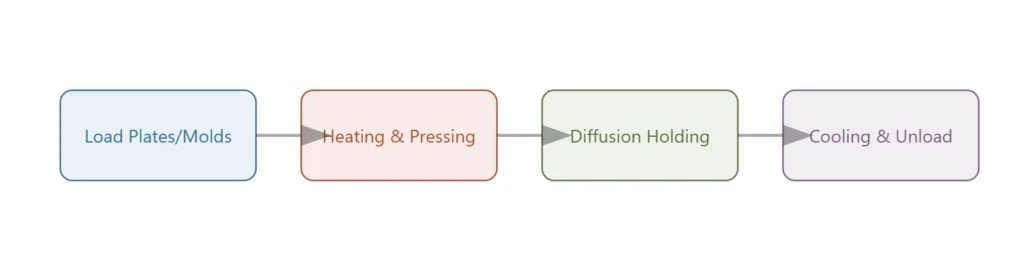
- Multi-Stage Process Programming: The HMI allows for complex “recipes” involving stepped heating, pressure ramping, vacuum/inert gas dwelling, and controlled cooling phases.
- Rapid Cooling System: Integrated with a water-cooled platen system or forced nitrogen cooling to significantly reduce the cycle time after the bonding phase is complete.
- Parallelism & Flatness Control: Precision-guided pillars and high-stiffness frames ensure that the platens remain perfectly parallel, maintaining VC flatness tolerances within ±0.05mm±0.05mm.
- Vacuum/Inert Gas Option: Can be equipped with a sealed chamber for bonding under vacuum or nitrogen (N2N2) to prevent copper oxidation and ensure a pristine internal environment.
Technical Parameters
| Item | Specification Detail |
|---|---|
| Model | CT-VC-HP (Hot Press) |
| Max Pressing Force | 50T / 100T / 200T / 500T (Customizable) |
| Platen Size | 300mm×300mm∼600mm×600mm300mm×300mm∼600mm×600mm |
| Max Working Temp. | Standard: 700∘C700∘C; High-temp: 1000∘C1000∘C |
| Temp. Uniformity | ≤±5∘C≤±5∘C |
| Heating Method | Electric Resistance / Induction Heating |
| Stroke Range | 100mm∼300mm100mm∼300mm |
| Control System | High-performance PLC + 15″ Industrial Touchscreen |
| Cooling Method | Internal Water-Cycle Cooling |
| Safety System | Dual-hand Start, Light Curtains, Over-temp Interlocks |
Workflow Diagram
Applications
- Smartphone VCs: Large-scale diffusion bonding of ultra-thin (0.3mm) copper VCs.
- GPU & AI Accelerator Cooling: Fabricating heavy-duty VCs with complex internal pillar arrays.
- High-Power LED Heat Sinks: Bonding specialized thermal spreaders for stadium and automotive lighting.
- Power Modules: Creating high-reliability cold plates for IGBTs and EV inverters.
FAQ
Q1: What is Diffusion Bonding and why is it used for VCs?
A: Diffusion bonding is a solid-state welding technique. By applying heat and pressure, copper atoms migrate across the joint interface. Unlike brazing, it requires no filler metal (which could clog the wick), and the resulting joint is as strong as the parent copper itself.
Q2: How do you prevent the thin VC plates from warping during the high-heat phase?
A: We use Precision Graphite or High-Temp Alloy Molds (fixtures). The VCs are placed inside these molds, which provide uniform mechanical support. Our machine’s ability to maintain perfectly parallel platens further ensures the VCs remain flat.
Q3: Can the machine sinter the copper powder and bond the plates at the same time?
A: Yes. This is a common practice. The “Sinter-Bonding” cycle uses a specific temperature and pressure profile that first sinters the powder wick into a porous structure and then diffusion-bonds that wick and the plates together in one efficient cycle.
Q4: How long is a typical bonding cycle?
A: Depending on the thickness of the VC and the material, a cycle can range from 45 minutes to 3 hours. This includes the ramp-up time, the “soak” time for bonding, and the critical cooling phase. Multi-layer machines can process hundreds of VCs per cycle to maintain high output.
Q5: What safety measures are in place for high-temperature operation?
A: The machine features a water-cooled outer frame to keep external surfaces safe to touch. It also includes independent over-temperature protection, smoke detectors, and a dual-hand start-up safety protocol to protect the operator.