
Secondary degassing machine
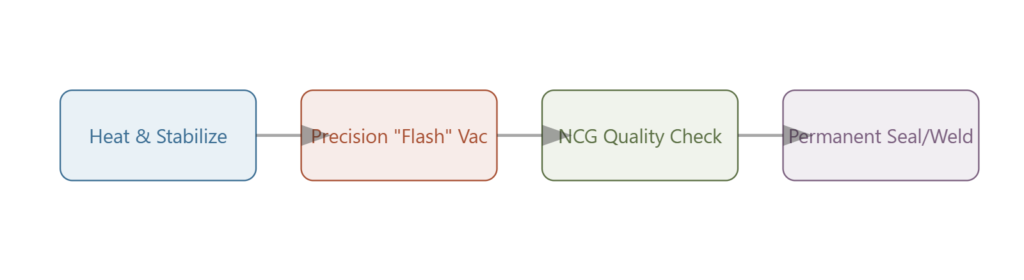
The Secondary Degassing Machine is a high-precision vacuum system used to perform the final “purification” of a heat pipe’s internal environment. After the pipe has been filled and aged (or heated), trace amounts of gas often remain or are generated. This machine uses a “Thermal Purge” or “Heated Vacuum” process: it heats the heat pipe to a specific temperature to drive all residual NCGs to the filling tail, then performs a rapid, high-vacuum “flash” to remove them before the final hermetic weld. This ensures that 100% of the active length of the heat pipe is available for phase-change heat transfer.
Key Features
- Thermal-Gradient Degassing: Features independent heating jackets that create a temperature gradient, pushing non-condensable gases toward the vacuum port for efficient removal.
- Precision “Flash” Evacuation: Employs a high-speed vacuum valve and a secondary high-vacuum pump set (Diffusion or Turbo) to capture microscopic gas volumes without excessive fluid loss.
- Integrated Permanent Sealing: Most secondary degassing units are combined with a high-precision TIG Welding or Ultrasonic Sealing head to permanently seal the pipe while it is under peak vacuum.
- Micro-NCG Detection: High-sensitivity vacuum sensors detect the “partial pressure” of remaining gases, ensuring the pipe is only sealed once the internal atmosphere is ultra-pure.
- PLC-Controlled Aging Profiles: Allows the operator to program complex “Heat-Hold-Vacuum” recipes to suit different pipe diameters and wick structures.
- Data Traceability: Automatically logs the final vacuum level and welding parameters for every individual pipe, providing a full “thermal birth certificate” for high-reliability applications.
Technical Parameters
| Item | Specification Detail |
|---|---|
| Model | CT-HP-SD 系列 (Secondary) |
| Ultimate Vacuum | ≤5.0×10⁻³≤5.0×10⁻³ Pa to 1.0×10−41.0×10−4 Pa |
| Heater Temp. Range | Ambient to 200∘C200∘C (PID Controlled) |
| Vacuum Pump Set | Dual-Stage Rotary + High-Vacuum Diffusion/Turbo |
| Welding/Sealing Type | TIG Arc Welding / Ultrasonic Cold Weld |
| Sealing Cycle Time | 60∼18060∼180 seconds (including heating time) |
| Stations | 4, 6, or 8 Independent Stations |
| Control System | High-end PLC + Windows-based Industrial HMI |
| Vacuum Gauge | Combined Pirani / Cold Cathode (Full Range) |
Workflow Diagram
Applications
- High-End Computing: Degassing for server and GPU cooling modules.
- Aerospace: Final sealing for LHP (Loop Heat Pipes) and space-grade thermal links.
- Medical Devices: Pure vacuum sealing for noise-free, ultra-efficient cooling probes.
- Automotive: Long-life sealing for EV battery thermal management systems.
FAQ
Q1: Why can't we just do one single degassing step?
A: Air is “sticky” at the molecular level. Much of it is absorbed by the porous copper wick or dissolved in the water. Heating the pipe during the Secondary stage is the only way to release these deep-seated molecules. Without this second step, the pipe will suffer from a “cold end” within weeks or months of operation.
Q2: Does the "Flash" vacuum cause fluid loss?
A: A tiny amount of fluid is lost (purged) to ensure all air is pushed out. Our machine uses a High-Speed Solenoid Valve with millisecond-precision timing. We calculate the exact “over-fill” needed in the first stage to compensate for this precision purge, ensuring the final fluid mass is perfect.
Q3: What is the difference between TIG welding and Ultrasonic sealing for the final step?
A:
- TIG Welding: Better for thicker industrial pipes; creates a very robust fused joint.
- Ultrasonic Sealing: Ideal for ultra-thin pipes and VCs; it creates a “cold weld” that doesn’t involve high heat, preventing damage to the delicate internal structure of micro-heat pipes.
Q4: Can we detect a "bad" pipe during the secondary degassing?
A: Yes. If the vacuum level refuses to drop to the target (e.g., 10−410−4 Pa) after the heating cycle, it indicates a micro-leak or severe internal contamination. The machine will trigger an alarm and refuse to weld the pipe, saving material and costs.
Q5: How many pipes can one machine process?
A: Because secondary degassing requires a heating and stabilization period, it takes longer than primary degassing (2∼3 minutes). We recommend a 6-station or 8-station configuration to keep up with high-volume assembly lines.