
Conveyor Automatic Sand Blasting Machine
The Conveyor Automatic Sand Blasting Machine is designed for the continuous, high-volume surface processing of flat or cylindrical components. Utilizing a variable-speed conveyor belt, the system moves heat pipes or vapor chambers through a sealed blasting chamber where multiple oscillating nozzles deliver a consistent stream of abrasive media (such as glass beads or aluminum oxide). This process ensures a perfectly uniform surface roughness and a clean, professional aesthetic while maintaining a high throughput that matches the speed of automated assembly lines.
Key Features
- Continuous Conveyor Operation: Features a high-durability, anti-static conveyor belt with adjustable speeds to match different production requirements.
- Multi-Nozzle Oscillating System: Equipped with 6 to 12 high-efficiency blast nozzles that oscillate to ensure 100% coverage and a streak-free finish across the entire width of the belt.
- Automatic Media Recovery: Integrated with a cyclone separator and a heavy-duty vibrating screen to automatically filter, clean, and recycle abrasive media, reducing material costs.
- Dust Extraction & Filtration: High-capacity pulse-jet dust collector ensures a clean working environment and prevents the escape of fine particles into the factory floor.
- Adjustable Blast Intensity: Precision pressure regulators allow the operator to fine-tune the impact force, preventing the deformation of ultra-thin (0.3mm) vapor chambers.
- PLC-Controlled Interface: Simple touchscreen controls for belt speed, nozzle oscillation frequency, and blasting time, with built-in maintenance alerts for nozzle wear.
Technical Parameters
| Item | Specification Detail |
|---|---|
| Model | CT-HP-SBM (Conveyor) |
| Conveyor Width | 600mm/800mm/1000mm600mm/800mm/1000mm (Customizable) |
| Number of Nozzles | 6 / 8 / 12 Nozzles (Independent Control) |
| Nozzle Oscillation | Servo-driven / Frequency-controlled |
| Belt Speed | 0.5∼50.5∼5 meters/minute (Adjustable) |
| Air Consumption | 6∼15 m3/min6∼15 m3/min (depending on nozzle count) |
| Abrasive Media | Glass Beads, Alumina, Ceramic Beads, Steel Grit |
| Dust Collection | Pulse-Jet Bag/Cartridge Filter (99.9%99.9% efficiency) |
| Control System | PLC + HMI Touchscreen |
| Power Supply | AC 380V, 3-Phase, 50/60Hz |
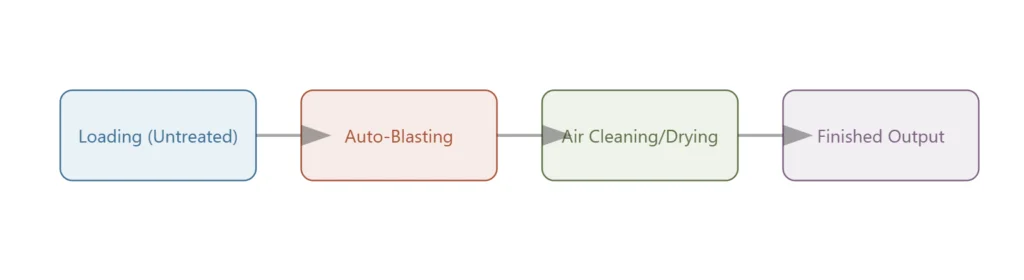
Workflow Diagram
Applications
- Heat Pipes & VCs: Removal of oxide scales after sintering and bonding.
- Heatsinks: Surface texturing of aluminum extrusions for improved heat radiation.
- Electronic Housings: Deburring and matte-finishing of metal laptop/phone frames.
- Industrial Components: Pre-plating treatment for various non-ferrous parts.
FAQ
Q1: Why is sandblasting necessary for heat pipes after sintering?
A: During the sintering process, copper is exposed to high temperatures which can create a dark oxide layer or localized discoloration. Sandblasting removes this layer to reveal a clean, uniform “satin” finish, which is not only more aesthetically pleasing but also improves the adhesion of secondary coatings like nickel plating.
Q2: Will the sandblasting process bend or dent ultra-thin vapor chambers?
A: No. Our machine features Low-Pressure Precision Control. By using finer media (like #200 glass beads) and reducing the air pressure, the machine can clean even 0.3mm thick VCs without causing any mechanical deformation or surface pitting.
Q3: How often do I need to replace the abrasive media?
A: The machine has a built-in Cyclone Media Recovery System. It continuously separates the broken “dust” from the good abrasive particles. You only need to “top-up” the media occasionally (typically once a week in high-volume shifts) as the particles slowly wear down.
Q4: Can the machine process different shapes at the same time?
A: Yes. The conveyor design is “blind” to the shape of the parts. As long as the components fit within the width of the belt and the height of the tunnel, you can process a mix of round pipes, flat pipes, and vapor chambers simultaneously.
Q5: How do you prevent dust from contaminating the rest of the factory?
A: The blasting chamber is kept under Negative Pressure. The high-powered dust collector pulls all air inward, ensuring that no dust escapes through the conveyor entry or exit points. The system is safe for use even in standard electronics assembly environments.