
Heat Pipe Multi-station Dry-out Tester
The Heat Pipe Multi-station Dry-out Tester (also known as the Qmax Tester) is a high-precision diagnostic system designed to measure the maximum heat transfer capacity (QmaxQmax) and thermal resistance (RthRth) of heat pipes and vapor chambers. By simulating real-world thermal loads using high-stability heating modules and constant-temperature cooling blocks, this equipment allows manufacturers to verify the internal quality (wick structure, fluid fill, and vacuum integrity) of multiple units simultaneously. It is an essential tool for both high-volume production QC and advanced thermal R&D.
Key Features
- High-Efficiency Multi-station Design: Available in 4, 8, or 10-station configurations (customizable), allowing for simultaneous testing to significantly increase production throughput.
- Precision Power & Temp Control: Utilizes PID closed-loop control to ensure heating power stability within ±0.1W±0.1W and temperature sensing accuracy up to ±0.1∘C±0.1∘C.
- Automated Data Analysis: Integrated industrial PC with proprietary software records real-time T−tT−t (Temperature vs. Time) curves and automatically calculates thermal resistance and the “dry-out” threshold.
- Adjustable Orientation Testing: The platform supports 0° to ±90∘±90∘ tilting to evaluate “anti-gravity” performance, simulating different installation angles in end-devices like laptops or servers.
- Stable Pneumatic Clamping: Pneumatic cylinders ensure consistent contact pressure between the sensors/blocks and the heat pipe, eliminating human error and ensuring repeatable results.
- Safety & Dry-out Protection: Built-in over-temperature protection automatically cuts off power if a “dry-out” occurs, preventing damage to the samples or the heating blocks.
Technical Parameters
| Item | Specification |
|---|---|
| Model | CT-HP-QMAX Series |
| Test Stations | 4 / 8 / 10 Stations (Customizable) |
| Heating Power Range | 0 – 300W per station (Independent control) |
| Temperature Sensors | High-precision T-type or K-type thermocouples |
| Sensor Resolution | ±0.1∘C±0.1∘C |
| Cooling Method | Constant temperature water cooling (Chiller required) |
| Tilt/Test Angle | 0∘∼180∘0∘∼180∘ (Manual or Motorized) |
| Control System | PLC + Industrial PC (Windows-based UI) |
| Compressed Air | 0.4 – 0.6 MPa |
| Power Supply | AC 220V, 50/60Hz |
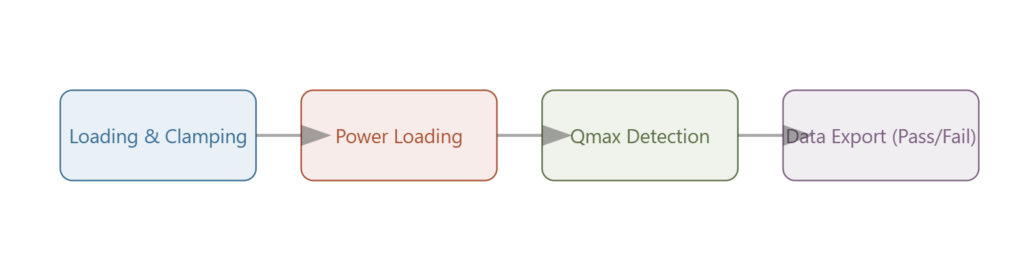
Workflow Diagram
Applications
- Consumer Electronics: Testing ultra-thin heat pipes for smartphones, tablets, and laptops.
- Data Centers: Verifying high-power thermal modules for CPUs, GPUs, and server racks.
- Electric Vehicles (EV): Performance validation of cooling pipes for battery thermal management systems (BTMS).
- Telecom & 5G: Stability testing for base station heat dissipation components under extreme loads.
Note: This system typically serves as the final inspection stage in the heat pipe production line, following the “Degassing and Welding” process, to ensure 100% thermal compliance before assembly.
FAQ
Q1: What exactly is "Dry-out" (Qmax) and why is it the most critical test?
A: Dry-out occurs when the heat load exceeds the heat pipe’s capillary limit; the working fluid evaporates faster than the wick can return it to the evaporator. Testing for Qmax identifies the absolute thermal limit of your product, ensuring it won’t fail (overheat) when the end-user’s CPU/GPU hits peak performance.
Q2: Can one machine test both Round Heat Pipes and Flat Vapor Chambers (VC)?
A: Yes. The system is designed with modular clamping heads. By simply swapping the copper heating/cooling blocks, you can switch between testing standard cylindrical pipes, flattened pipes, or large Vapor Chambers on the same machine.
Q3: How many stations do I need for my production line?
A:
- 4-Station: Ideal for R&D labs and small-batch pilot runs.
- 8 to 10-Station: Recommended for high-volume mass production lines to match the takt time of the assembly process.
Q4: Does the system include a cooling source?
A: The tester includes the water-cooled manifolds and control valves. However, it requires a Constant Temperature Water Chiller to supply the coolant. We can provide this as a bundled package or you can connect it to your factory’s existing chilled water loop.
Q5: How do you ensure the temperature readings are accurate?
A: We use high-grade T-type thermocouples and a pneumatic “Pre-load” mechanism. The pneumatic cylinders apply a constant, calibrated force to the sensors, ensuring zero-gap contact with the heat pipe surface, which is the most common cause of data error in manual testing.
Q6: Can the test data be exported for Quality Traceability?
A: Absolutely. Our proprietary Windows software automatically logs every test cycle. You can export data in CSV or Excel formats, including the maximum power reached, thermal resistance values, and time-stamped temperature curves for your QC records.
Q7: How often does the heating block need calibration?
A: We recommend a standard calibration check every 6 to 12 months. The software includes a calibration offset mode that allows you to easily sync the sensors with a reference thermometer.