
Vapor Chamber Fully automatic laser sealing machine
The Vapor Chamber Fully Automatic Laser Sealing Machine is the definitive solution for the mass production of high-performance flat thermal spreaders. Designed for the delicate nature of Vapor Chambers, the system performs the final seal at the filling tail immediately after the degassing phase. By utilizing a non-contact laser process combined with advanced CCD Vision Alignment, the machine achieves a high-strength, leak-proof weld without applying mechanical pressure that could deform the thin copper skins or collapse the internal support pillars.
Key Features
- Precision for Ultra-Thin VCs: Optimized for sealing Vapor Chambers with wall thicknesses from 0.3mm to 1.0mm, ensuring zero deformation of the flat cooling surface.
- AI-Enhanced CCD Alignment: High-resolution cameras detect the precise position of the VC’s filling stem, automatically compensating for any placement offsets in the X,Y,X,Y, and θθ axes.
- Atmospheric Shielding Gas Control: Features an integrated Argon/Nitrogen shielding nozzle to prevent the oxidation of the copper surface during the laser pulse, resulting in a clean, golden-colored weld.
- Interference-Free Non-Contact Sealing: Unlike ultrasonic or mechanical crimping, the laser process creates no vibration, protecting the delicate internal sintered powder or mesh wick structure.
- Scalable Automation: Can be configured as a standalone rotary unit or a fully integrated linear module that connects directly to the vacuum degassing line.
- Real-Time Weld Monitoring: Includes a coaxial vision system that allows operators to monitor the melt pool in real-time, with an optional “Auto-Reject” feature for inconsistent welds.
Technical Parameters
| Item | Specification Detail |
|---|---|
| Model | CT-VC-LS (Vapor Chamber Laser) |
| Laser Source | Fiber Laser (500W – 1500W) |
| Applicable VC Size | 20mm×20mm20mm×20mm to 300mm×300mm300mm×300mm |
| Min. VC Thickness | 0.3 mm |
| Positioning Accuracy | ±0.01mm±0.01mm |
| Welding Time | 0.3∼1.50.3∼1.5 seconds per unit |
| Shielding Gas | High-Purity Argon (Ar) / Nitrogen (N2N2) |
| Workpiece Tray | 4, 8, or 12 Station Indexing Table |
| Control System | PC-Based Motion Controller + 17″ Touch Monitor |
| Machine Dimensions | 1400mm×1100mm×1750mm1400mm×1100mm×1750mm |
Workflow Diagram
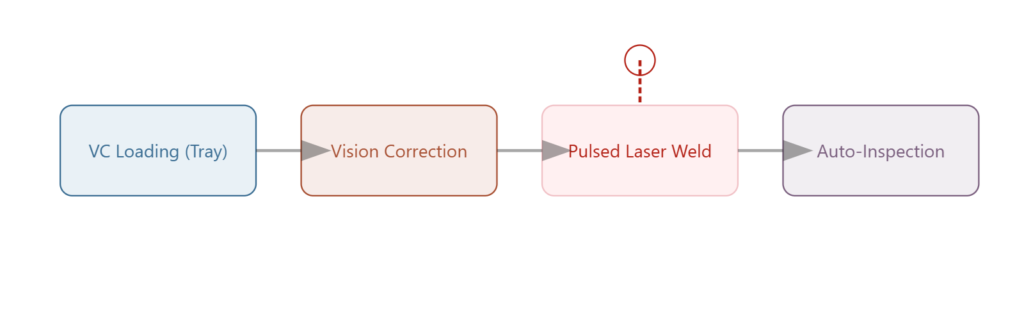
Applications
- Smartphone VCs: The standard for ultra-thin (0.3mm – 0.4mm) copper VCs used in flagship mobile devices.
- High-End Computing: Sealing large-area VCs for GPU coolers and AI accelerators.
- 5G Networking: Sealing high-power thermal spreaders for base station power amplifiers.
- New Energy (EV): Precision sealing for inverter cold plates and battery thermal spreaders.
FAQ
Q1: Why is Laser Sealing mandatory for smartphone VCs?
A: Smartphone VCs are extremely thin. Mechanical sealing methods like TIG or Ultrasonic can cause the copper plates to buckle or the internal support pillars to fail. Laser sealing is a “no-load” process that only melts the target tip, maintaining the perfect flatness required for contact with the mobile SoC.
Q2: Can the machine handle irregular-shaped VCs (not just squares)?
A: Yes. The CCD Vision System is trained to recognize irregular shapes. As long as the filling stem is within the camera’s field of view, the machine will identify the welding path regardless of the VC’s overall geometry.
Q3: How do you prevent "Leakers" in mass production?
A: We use Fiber Laser Sources with extreme power stability (≤1%≤1%). Combined with a precise Argon shielding system and a high-accuracy servo-Z axis to maintain the perfect focal point, the “Leaker” rate is typically reduced to less than 0.05%.
Q4: Is the machine compatible with Vapor Chambers that have no "stem"?
A: While most automated lines use a stem for filling, we also offer specialized Edge-Sealing laser configurations for “stem-less” VCs. Please specify your VC design when requesting a quote.
Q5: What is the maintenance cycle for the Fiber Laser?
A: The Fiber Laser is virtually maintenance-free for its 100,000-hour lifespan. The only daily maintenance required is cleaning the protective lens and ensuring the water chiller is filled with deionized water.