
Primary Degassing Machine
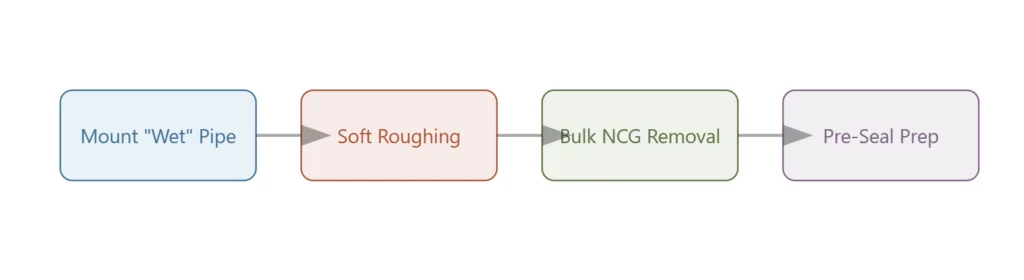
The Primary Degassing Machine is designed for the high-speed initial evacuation of heat pipes and vapor chambers immediately after the fluid filling process. At this stage, the pipe contains both the working fluid (e.g., deionized water) and a significant volume of atmospheric air. The machine performs a controlled “roughing” and “fine” vacuum sequence to remove 99.9% of the air while preventing the working fluid from being sucked out (flash evaporation control). This process is essential to establish the basic vacuum environment required for the heat pipe’s thermal cycle to function.
Key Features
- Two-Stage Vacuum Logic: Utilizes a “Soft-Start” roughing phase to prevent fluid surging, followed by a deep vacuum phase to remove dissolved gases from the wick and fluid.
- Fluid Loss Prevention: Features a specialized “Condensate Trap” or chilled baffle that prevents the working fluid (water/methanol) from entering the vacuum pump, protecting the pump and maintaining fluid volume accuracy.
- High-Throughput Manifold: Typically configured with 4, 8, or 10 stations to handle the high volume of pipes coming from the filling department.
- Synchronized Sealing Interface: Often works in tandem with a temporary sealing or “necking” tool to hold the vacuum until the pipe can be permanently welded.
- Contamination Control: Uses oil-mist filters and stainless steel internal surfaces to ensure that no pump oil or external impurities enter the “wet” heat pipe.
- Real-time Pressure Logging: Monitors the “Pull-down Curve” for each station to ensure that every pipe reaches the required primary vacuum level before unloading.
Technical Parameters
| Item | Specification Detail |
|---|---|
| Model | CT-HP-PD 系列 (Primary) |
| Number of Stations | 4, 8, or 10 Stations |
| Primary Vacuum Level | ≤1.0×10⁻¹≤1.0×10⁻¹ Pa to 5.0×10−25.0×10−2 Pa |
| Cycle Time | 45∼9045∼90 seconds (Standard pipe) |
| Vacuum Pump | High-speed Dual-Stage Rotary Vane Pump |
| Cooling Trap Temp. | −5∘C∼+5∘C−5∘C∼+5∘C (Optional) |
| Control System | PLC + HMI with Pressure-Step Logic |
| Manifold Material | SUS 304 / 316 (Mirror Polished) |
| Power Supply | AC 220V/380V, 50/60Hz |
Workflow Diagram
Applications
- Standard Manufacturing: Every copper-water heat pipe requires primary degassing.
- VC Production: Initial air removal for Vapor Chambers after filling.
- High-Volume Lines: The “workhorse” station for consumer-grade thermal modules.
FAQ
Q1: What is the difference between Primary Degassing and Secondary (Final) Degassing?
A: Primary degassing removes the bulk air and dissolved gases immediately after filling. Secondary degassing (usually done after a “baking” or aging process) removes the residual NCG that only releases after the pipe has been heated and cycled.
Q2: Will the vacuum pull the working fluid out of the pipe?
A: This is a major risk. Our machine uses “Step-Evacuation.” We start with a slow roughing speed to let the air escape without causing the fluid to boil violently. Once the bulk air is gone, we switch to a higher vacuum.
Q3: How do we know if the primary degassing was successful?
A: The machine monitors the Vacuum Rate of Rise. After the vacuum is pulled, the valves are closed for a few seconds. If the pressure stays low, it means the bulk air is gone. if it rises quickly, there is either a leak or too much air still trapped in the fluid.
Q4: Does this machine also weld the pipe?
A: Usually, no. The Primary Degassing machine is often a stand-alone station that “necks” or temporary-seals the pipe. The pipe is then moved to a dedicated welding station to ensure the degassing ports aren’t tied up during the welding time.
Q5: Can I test different fluids (like Alcohol or Acetone) on this machine?
A: Standard machines are built for water. If using volatile fluids like Alcohol, we must equip the machine with Explosion-Proof (Ex) pumps and specialized chemical-resistant seals.