
Vacuum Sintering Furnace
The Vacuum Sintering Furnace is a high-capacity, batch-type thermal system designed for the sintering of copper powder wicks and the diffusion bonding of heat pipe assemblies. The furnace provides a strictly controlled environment where high temperatures (600∘C600∘C to 1000∘C1000∘C) and deep vacuum levels (up to 10−410−4 Pa) work together to create molecular-level bonds between copper particles and the tube wall. This process results in a wick with optimized porosity and capillary pumping pressure, ensuring the heat pipe can transport heat efficiently over long distances or against gravity.
Key Features
- Deep Vacuum & Reducing Atmosphere: Capable of reaching high vacuum levels to prevent oxidation, with optional hydrogen (H2H2) or nitrogen-hydrogen (N2/H2N2/H2) gas injection to “clean” the copper surfaces during the cycle.
- Multi-Zone Temperature Uniformity: Features high-grade molybdenum or graphite heating elements arranged in multiple zones to maintain a temperature uniformity of ±3∘C±3∘C across the entire hot zone.
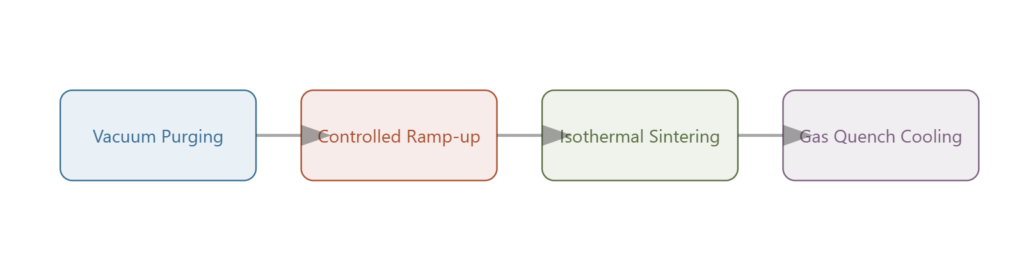
- Programmable Sintering Profiles: Advanced HMI allows for precise control of heating rates, “soak” times at sintering plateaus, and multi-stage cooling ramps to prevent thermal stress or warping.
- High Batch Capacity: Available in various chamber sizes (from 300mm300mm to 1200mm1200mm deep) to process thousands of heat pipes or hundreds of VCs in a single production run.
- Advanced Safety Protection: Integrated with water-flow sensors, over-temperature interlocks, and hydrogen gas safety systems (explosion-proof valves and flame monitors).
- Rapid Cooling Technology: Equipped with a high-speed centrifugal fan and a specialized heat exchanger for rapid gas quenching, significantly shortening the total cycle time.
Technical Parameters
| Item | Specification Detail |
|---|---|
| Model | CT-HP-VSF Series |
| Ultimate Vacuum | 5.0×10−15.0×10−1 Pa (Rough) to 5.0×10−45.0×10−4 Pa (High Vac) |
| Max Working Temp. | 1000∘C1000∘C (Standard); 1300∘C1300∘C (Custom) |
| Temp. Uniformity | ≤±3∘C∼±5∘C≤±3∘C∼±5∘C |
| Chamber Dimensions | 400×400×600mm400×400×600mm up to 1000×1000×1500mm1000×1000×1500mm |
| Atmosphere Support | Vacuum / N2N2 / ArAr / H2H2 (Reducing) |
| Heating Elements | Molybdenum (Mo) / Graphite / Fe-Cr-Al Alloy |
| Cooling Method | Internal Gas-Circulation Quenching / Water-Cooled Jacket |
| Control System | PLC + PC-based SCADA for Data Logging |
Workflow Diagram
Applications
- Heat Pipe Manufacturing: Sintering spherical or irregular copper powder onto the inner walls of pipes.
- Vapor Chamber (VC) Fabrication: Simultaneous sintering of the wick and diffusion bonding of the copper plates.
- Micro-Electronics: Annealing and degassing of copper components for ultra-clean applications.
- Aerospace Thermal Links: Processing high-purity thermal components under rigorous vacuum standards.
FAQ
Q1: Why is a vacuum required for sintering copper?
A: At high temperatures, copper reacts instantly with oxygen to form copper oxide (CuOCuO). This oxide layer prevents the copper particles from bonding (fusing) together and significantly degrades the thermal conductivity. A vacuum or reducing atmosphere keeps the copper pure and bright.
Q2: What is the benefit of adding Hydrogen (
A: Hydrogen acts as a reducing agent. It chemically reacts with any existing surface oxides on the copper powder, turning them back into pure copper and water vapor. This ensures the strongest possible bond between the wick and the pipe wall.
Q3: Can I process heat pipes of different lengths in the same batch?
A: Yes, as long as the pipes are loaded into the furnace in compatible jigs or trays. The uniform heating zones ensure that all pipes, regardless of their position in the chamber, receive the same thermal energy.
Q4: How do I control the "Porosity" of the wick during sintering?
A: Porosity is controlled by the combination of Sintering Temperature and Hold Time. Higher temperatures or longer times will lead to more fusion and smaller pores (higher density). Our precise PLC control allows you to fine-tune these variables to achieve your specific thermal design requirements.
Q5: What is the typical "Quench" time?
A: After sintering at 900∘C900∘C, the furnace can take many hours to cool naturally. Our High-Speed Gas Quench system can bring the load down to a safe handling temperature (<100∘C<100∘C) in 60 to 90 minutes, allowing for more batches per day.