1. What Is a Vapor Chamber Fully Automatic Laser Sealing Machine?
A vapor chamber fully automatic laser sealing machine seals vapor chamber components after processing inside of the chamber.
The laser sealing machine joins metal surfaces using a focused beam of laser light.
Thus, vapor chamber sealing creates a controlled and precise bonding process.
Vapor chambers need a consistent and reliable enclosure seal.
Inside of this sealed environment, a working fluid and internal wick structure allows for advanced phase-change heat transfer.
Thus, sealing quality can impact vapor chamber thermal performance and product reliability.
Some advantages of a fully automatic vapor chamber sealing machine include integration of many production steps into one system.
This can include:
- Product Positioning
- Automatic Loading
- Precision Alignment
- Laser Welding
- Process Monitoring
- Inspection
- Automatic Unloading
Thus, reduced manual handling is possible during vapor chamber production with automation.
Production consistency can also be increased with a fully-automatic system.
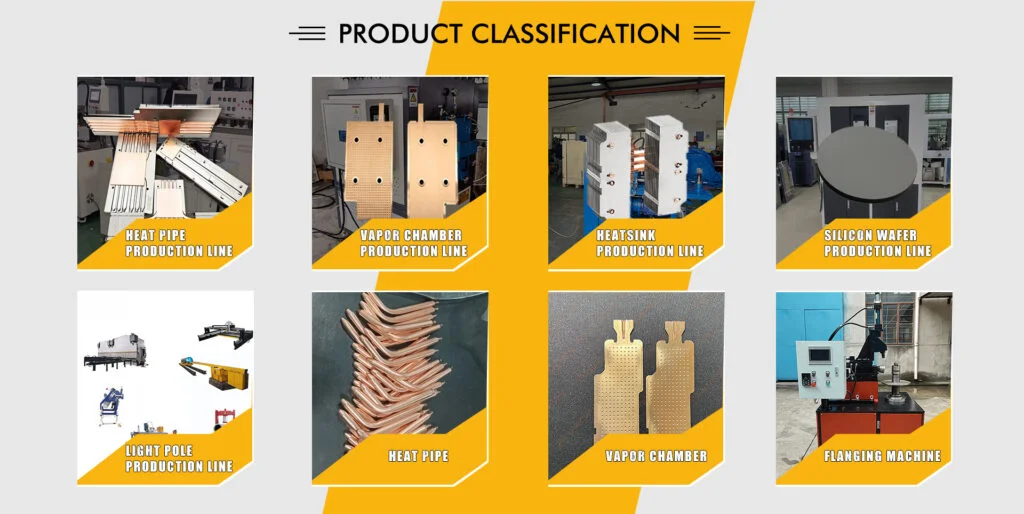
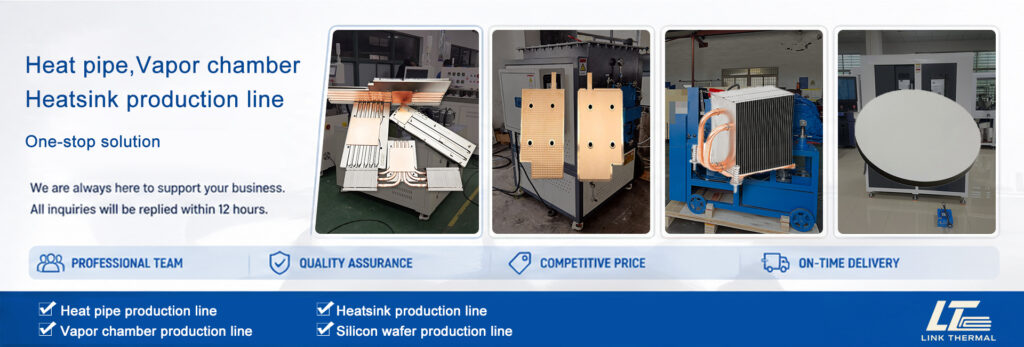
For more manufacturing technology, see 【 Vapor Chamber Production Line 】
2. Why Laser Sealing Matters for Vapor Chambers
Vapor chambers work by rapidly spreading heat through phase-change technology.
Essentially, the vapor chamber creates a controlled environment within the enclosure.
As a result, vapor chamber manufacturers must create a reliable sealed enclosure.
Any flaws in the seal can compromise vapor chamber performance.
For instance, improper sealing may allow gases to infiltrate the chamber.
Likewise, working fluid may leak out of the enclosure.
As a result, vapor chamber manufacturers should use precise sealing equipment.
Laser welding offers many benefits for sealing vapor chambers.
A laser focuses energy to a small welding point.
As a result, heat input and the resulting heat-affected zone can be controlled.
In addition, laser processing is highly compatible with automated production.
As a result, laser welding is ideal for mass production of vapor chambers.
3. How Does a Vapor Chamber Laser Sealing Machine Work?
Each step in the sealing process follows a set sequence.
First, the vapor chamber is positioned and loaded into the machine.
Next, the sealing edges are precisely aligned.
Then, the laser head moves according to a pre-programmed welding path.
As the laser melts metal along the joint, a molten pool forms.
When this pool cools, a continuous weld seam is created.
As a result, the machine produces a sealed vapor chamber assembly.
A simplified process could include the following stages:
Loading → Positioning → Alignment → Laser Sealing → Inspection → Unloading
By integrating each stage into a fully-automatic system, manual intervention can be reduced.
Exact laser parameters will vary based on chamber material and design.
Key parameters can include:
- Laser power
- Welding speed
- Beam diameter
- Pulse settings
- Welding path
- Focus position
As a result, engineers should verify the optimal parameters during product testing.
4. Key Features of Automatic Laser Sealing Equipment
Here are some key features to look for in a Vapor Chamber Fully Automatic Laser Sealing Machine.
Automatic Loading
Many vapor chamber sealing machines come with automatic loading capabilities.
Thus, operators can reduce the time spent positioning workpieces.
Precision Positioning
Small deviations in laser welding can create weak joints.
Thus, the machine should hold parts in the exact same position during each production run.
Programmable Laser Welding
Laser parameters can be set using a machine control system.
Thus, one machine can produce vapor chambers with different designs.
Real-Time Process Monitoring
Modern laser sealing machines use sensors to monitor the welding process.
Thus, issues in the welding process can be detected quickly.
Automatic Inspection
Automated inspection features can verify seal quality.
Depending on the equipment model, inspection can cover:
- Weld appearance
- Position accuracy
- Surface defects
- Dimensional characteristics
Thus, automatic inspection provides better production oversight.
Automatic Unloading
Automated equipment can move completed vapor chambers from the machine.
Thus, finished goods can be rapidly transferred to another process.
5. Vapor Chamber Laser Sealing Process
The laser sealing process may include multiple stages.
Step 1: Chamber Preparation
Prior to sealing, technicians prepare the inside and outside of the vapor chamber.
Exact dimensions are crucial to the sealing process.
As a result, preparation steps can influence sealing quality.
Step 2: Component Positioning
The machine positions the vapor chamber into a sealing fixture.
Thus, the fixture will secure the vapor chamber in the proper location.
Step 3: Alignment
Next, the sealing machine ensures the laser weld path is aligned.
Thus, the laser will travel along the correct sealing path.
Step 4: Laser Welding
Using a focused laser beam, metal is melted along the vapor chamber edge.
Thus, the weld forms a sealed enclosure.
Step 5: Weld Inspection
After welding, an inspection system checks the weld seam.
Thus, manufacturers can detect any weld defects.
Step 6: Vacuum Processing
During manufacturing, vapor chambers typically require vacuum processing.
Thus, sealing is often paired with or near the vacuum process.
Learn more: 【 Vapor Chamber Vacuum Process 】
Step 7: Working Fluid Filling
The enclosed space is filled with a working fluid.
Thus, the vapor chamber is ready to do its job.
Learn more: 【 Vapor Chamber Filling Process 】
Step 8: Final Testing
Finally, vapor chambers undergo various quality tests.
Testing can include:
- Leak tests
- Thermal Performance testing
- Dimensional inspections
- Weld inspections
Learn more: 【 Vapor Chamber Testing Process 】
6. Advantages of Fully Automatic Laser Sealing
Automation offers several benefits to vapor chamber production.
Higher Production Consistency
The automated welding path and process parameters remain consistent.
As a result, sealing quality can remain consistent between parts.
Improved Production Efficiency
Automatic loading and unloading reduces hands-on time.
Thus, production output can increase with automation.
Precise Energy Control
Since laser welding focuses energy into a small area, weld energy can be controlled.
As a result, manufacturers gain precise control over the laser welding process.
Reduced Heat Input
Lasers can be adjusted to minimize heat input.
As a result, heat input can be minimized around the sealing area.
Flexible Product Changeover
Automatic machines allow manufacturers to store different weld programs.
Thus, it’s possible to produce varying sizes of vapor chambers.
Better Process Traceability
Automatic systems can log process data to a file.
As a result, greater process traceability is possible.
7. Vapor Chamber Sealing Requirements
Effective vapor chamber sealing needs precise process control.
Here are some factors that can affect vapor chamber sealing quality.
Material Compatibility
The laser source should be appropriate for the material.
Vapor chambers are typically made from copper or stainless steel.
As a result, engineers should adjust laser parameters to match the material.
Joint Design
The shape of the vapor chamber joint can affect welding.
As a result, joint geometry should allow for stable welding conditions.
Surface Condition
Surface contamination can cause welding issues.
As a result, technicians should ensure surfaces are clean before sealing.
Fixture Accuracy
The machine fixture should hold the workpiece without movement.
As a result, proper fixtures can improve welding accuracy.
Laser Parameter Stability
Fluctuations in laser power can cause defects.
As a result, engineers should keep laser parameters stable.
8. Applications of Vapor Chamber Laser Sealing
Vapor chambers are used in many different electronics cooling applications.
GPU Cooling
GPUs can produce large amounts of heat in a small space.
As a result, vapor chambers can spread heat to larger surface areas.
Effective vapor chamber sealing is required for GPU cooling applications.
Learn more: 【 Vapor Chamber for GPU Cooling 】
CPU Cooling
Just like GPUs, CPUs need efficient heat spreading solutions.
As a result, vapor chambers are used for CPU cooling.
Data Center Cooling
Data center applications require effective heat dissipation.
As a result, thermal management is critical for server hardware.
vapor chambers can help spread heat loads in data centers.
Learn more: 【 Vapor Chamber for Data Center Cooling 】
Consumer Electronics
Heat dissipation is important for smartphones and laptops.
As a result, thin vapor chambers can be used for heat spreading.
Automotive Electronics
Power electronics in EV’s require efficient heat dissipation.
As a result, vapor chambers can be used for certain EV applications.
Learn more: 【 Vapor Chamber for EV Battery 】for more.
9. How to Choose the Right Laser Sealing Machine
Below are some factors to consider when choosing laser sealing equipment.
Consider Chamber Dimensions
What are the largest and smallest chambers you will seal?
As a result, the sealing machine should accommodate your vapor chamber sizes.
Consider Material
What material are your vapor chambers made of?
What is the material thickness?
As a result, you can choose the right laser for your material.
Consider Production Capacity
How many vapor chambers do you need to produce each day?
As a result, you’ll know if you need an automatic sealing machine.
Consider Welding Accuracy
Small variances in the weld can cause weak seals.
As a result, the sealing machine should provide tight position tolerances.
Consider Automation
Do you want a:
- Semi-automatic machine
- Fully-automatic sealing system
As a result, you should choose the level of automation that fits your production volume.
Consider Integration
How will the sealing machine connect to other processes?
- Cleaning
- Vacuum processing
- Filling
- Sealing
- Testing
- Packaging
As a result, machines that are integrated with other processes can optimize efficiency.
10. Vapor Chamber Production Line
A Vapor Chamber Fully Automatic Laser Sealing Machine is only one step in the overall production process.
An advanced vapor chamber production line might consist of:
- Material preparation
- Cleaning
- Forming
- Wick structure preparation
- Assembly
- Laser sealing
- Vacuum processing
- Working fluid filling
- Final sealing
- Thermal testing
- Quality inspection
Keeping this in mind, buyers should assess their entire production process.
For instance, the 【 Vapor Chamber Vacuum Machine 】 could assist with vacuum-related tasks.
The 【 Vapor Chamber Welding Machine 】 could assist with precision welding operations.
In the meantime, a Vapor Chamber Fully Automatic Laser Sealing Machine could automate sealing tasks.
A buyer could buy all these machines to construct a more comprehensive manufacturing solution.
11. Why Choose Bangwin Machine?
Bangwin Machine specializes in thermal manufacturing equipment and vapor chamber production solutions.
Bangwin Machine can service factories producing:
- Heat sinks
- Heat pipes
- Vapor chambers
- Thermal assemblies
What’s more, Bangwin Machine creates customized production equipment for thermal parts manufacturing.
Custom equipment from Bangwin Machine can be used for:
- Vapor chamber welding
- Laser sealing
- Vacuum processing
- Working fluid filling
- Thermal testing
- Automated assembly
Customers can have Bangwin Machine design equipment around their target vapor chamber models.
Factories building vapor chamber production lines will have to choose individual pieces of equipment that work well together.
Bangwin Machine allows customers to seamlessly connect the different parts of their vapor chamber production process.
Customers can learn more about Bangwin Machine’s thermal manufacturing solutions at:
Bangwin Machine Thermal Machinery
This website details the company’s thermal machinery offerings. Content covers heat sink production equipment, heat pipe manufacturing equipment, and vapor chamber welding machines.
Home
12. FAQ
- What is a Vapor Chamber Fully Automatic Laser Sealing Machine?
A Vapor Chamber Fully Automatic Laser Sealing Machine uses lasers to weld together vapor chamber units. The machinery can be configured to include part positioning, welding, inspection, and material transfer operations.
- Why does a vapor chamber need laser sealing?
Vapor chambers require a completely sealed container. Laser welding can be used to create a strong weld all the way around the vapor chamber. Since the laser welding process is highly controlled, manufacturers can rely on it to produce a quality seal every time.
- What materials can the machine seal?
Just about any material, but it depends on the laser. Copper and stainless steel are popular vapor chamber materials. Manufacturers should look at their material requirements and then find a laser that is compatible.
- Is laser sealing suitable for mass production?
Definitely. Industrial laser sealing can be easily automated. Plus, manufacturers can program the laser’s movement path. This makes laser welding ideal for bulk vapor chamber production.
- Can the machine support vapor chambers of different sizes?
Yes, if the machine is configured correctly. Programmable welding paths can be adjusted for different products. Additionally, machining fixtures can be swapped out to support various component sizes.
- What comes after vapor chamber laser sealing in the production process?
That will depend on how the vapor chambers are designed. Other steps of the production process might include vacuum processing, filling, final sealing, and testing. Buyers should identify the steps that come before and after laser sealing when searching for equipment.
- Can Bangwin Machine design customized vapor chamber production equipment?
Bangwin Machine can customize thermal production machines for customers.
Customers wanting to manufacture vapor chambers can benefit from Bangwin Machine’s welding, sealing, vacuum processing, filling, testing, and assembly equipment.
13. Conclusion
Vapor Chamber Fully Automatic Laser Sealing Machines allow manufacturers to automate their vapor chamber sealing process.
Industrial lasers can be programmed to deliver the same amount of energy every time. Factories can rely on this consistency to produce uniform welds across large quantities of vapor chambers.
Additionally, automation reduces the number of operators required to run the equipment. Factories can experience higher production volumes with less manual labor.
Customers should note that a Vapor Chamber Fully Automatic Laser Sealing Machine can be integrated into a larger production line.
After sealing, vapor chambers may go through vacuum processing, filling, testing, and assembly. Equipment that completes these tasks is available from Bangwin Machine.
Vapor chambers are critical heat dissipation components found in GPUs, AI servers, data centers, EV electronics, and high-performance computing devices. Demand will continue to expand as these industries expand.
With more vapor chamber demand comes a need for qualified production equipment. Bangwin Machine sells thermal processing machines and customized vapor chamber production solutions. Their product line includes heat pipes, heat sinks, and other thermal components.
Learn more about vapor chamber production machines at:
Bangwin Machine Thermal Machinery