1. What Is a Vapor Chamber Heatsink?
Here is a simple explanation.
A vapor chamber heatsink refers to a heatsink that uses a vapor chamber and fin-based heat dissipation structure.
Heat is spread well by the vapor chamber.
Heat is dissipated by the fins that are connected to the vapor chamber.
So, vapor chamber heatsinks provide excellent heat spreading performance and heat dissipation capability.
The heatsink we usually talk about uses a solid metal plate to conduct heat.
The vapor chamber heatsink, on the other hand, features phase change heat transfer inside of a sealed flat container.
As a result, it can quickly spread heat from a local heat source.
Vapor chamber heatsinks are especially suitable for high power density electronics with small installation spaces.
Such applications include:
- Graphics cards
- CPU heatsinks
- Servers
- Games consoles
- Telecom hardware
- Power electronics
- Industrial computers
- Automotive electronics
- Artificial intelligence (AI) boards
【 Vapor Chamber 】 and 【 What Is a Heat Sink 】
2. How Does a Vapor Chamber Heatsink Work?
A vapor chamber heatsink features phase change heat transfer technology as well as traditional fin heat dissipation.
Below are more details about its working principle.
2.1. Heat Absorption
The heat source contacts the vapor chamber heatsink.
The heat is transferred to the vapor chamber through the heater contact area (also known as the evaporator area).
Then the working fluid in the vapor chamber absorbs heat.
When the working fluid inside reaches the evaporation state, it begins to vaporize.
2.2 Vapor Movement
The vapor then moves to the low-temperature region in the vapor chamber.
In this way, the heat is spread over a larger area.
As a result, the vapor chamber is able to avoid local hot spots.
2.3 Condensation
The vapor is then condensed into liquid when it reaches a cool region.
As it condenses, the working fluid releases the heat that it absorbed.
2.4 Liquid Return
The wick structure inside returns the liquid to the heat source area.
The cycle repeats.
So the vapor chamber provides continuous spreading of heat.
2.5 Heat Dissipation Through Fins
Meanwhile, heat is transferred from the vapor chamber heatsink to the fin structure that is connected to it.
As air flows over the fins, heat is dissipated into the air.
In conclusion, vapor chamber heatsinks provide efficient heat spreading and heat dissipation functions.
3. Vapor Chamber Heatsink Structure
A vapor chamber heatsink is composed of multiple layers.
Vapor Chamber
The vapor chamber provides heat spreading.
It contains a sealed working fluid as well as a wick structure inside of it.
Wick Structure
The wick enables the liquid to be returned via capillary force.
There are various wick structures which provide different performance.
Working Fluid
The working fluid provides phase change heat transfer.
The working fluid is evaporated by heat, and condensed by releasing heat.
Metal Shell
The shell contains everything inside of it, creating a sealed chamber.
Since copper has high thermal conductivity and is not reactive with water, copper is commonly used.
Fin Assembly
The fins are what dissipate heat away from the vapor chamber.
They can be made out of aluminum or copper.
Thermal Interface
The bottom surface of the vapor chamber which contacts the heat source.
A proper interface can reduce thermal contact resistance.
4. Key Components of a Vapor Chamber Heatsink
Here are key components that determine vapor chamber heatsink performance.
4.1 Vapor Chamber Size
The size of the vapor chamber determines its heat spreading area.
However, it is limited by the space available for installation.
Designers should optimize the size based on the application.
4.2 Chamber Thickness
Thin vapor chambers can be useful for space constrained electronics.
However, thinner vapor chambers have impacts on the internal structure and manufacturing difficulty.
Designers should balance thickness with heat spreading performance.
4.3 Wick Structure
The wick helps circulate the liquid in the vapor chamber.
There are many different wick structures that can be used.
Here are some examples:
- Sintered powder wick
- Mesh wick
- Groove structure
- Composite wick structure
The appropriate wick structure will depend on required performance and operating position.
4.4 Fin Geometry
The fin design determines the air-side heat transfer performance of the heatsink.
Some important design considerations include:
- Thickness of fins
- Height of fins
- Distance between fins
- Fin density
- Orientation of fins
Designers should consider vapor chamber heat spreading as well as external heat dissipation.
4.5 Contact Area
Contact area between the vapor chamber and heat source also affects performance.
Engineers should ensure the contact surface has good flatness and finish.
5. Types of Vapor Chamber Heatsinks
Vapor chamber heatsinks come in different types for different applications.
5.1 Flat Vapor Chamber Heatsink
These vapor chamber heatsinks connect to a fin directly.
Flat vapor chamber heatsinks are commonly used in GPUs, CPUs, and other small electronics.
5.2 Embedded Vapor Chamber Heatsink
Instead of having the vapor chamber on top of the heatsink base, it is placed inside of it.
Doing so reduces the total thickness of the heatsink.
As a result, this heatsink style is suitable for space constrained products.
5.3 Copper Vapor Chamber Heatsink
Since copper has high thermal conductivity, copper vapor chambers are useful for high heat flux applications.
5.4 Vapor Chamber with Aluminum Fins
Heat capacity of aluminum is slightly lower than copper. By using aluminum fins, the overall weight of the heatsink can be reduced.
Pairing aluminum fins with copper vapor chambers allows for a good balance of weight and heat spreading performance.
5.5 Vapor Chamber with Copper Fins
Copper fins have higher thermal conductivity than aluminum fins.
The downsides is that it will increase the weight of the heatsink.
6. Vapor Chamber Heatsink vs Traditional Heatsink
A traditional heatsink uses solid metal to transfer heat.
A vapor chamber heatsink, however, uses phase change heat transfer with a vapor chamber.
Feature | Vapor Chamber Heatsink | Traditional Heatsink |
Heat spreading | Excellent | Good |
Local heat concentration | Handles well | More challenging |
Compact design | Excellent | Moderate |
Thermal uniformity | High | Moderate |
Manufacturing complexity | Higher | Lower |
Cost | Higher | Lower |
High heat flux | Excellent | Application dependent |
Integration | Highly customizable | Widely available |
Traditional heatsinks work well for many applications.
However, if a heat source is too concentrated, it will create a thermal bottleneck.
Because a vapor chamber can spread heat over a larger area, it helps.
7. Vapor Chamber Heatsink vs Heat Pipe Heatsink
Heat pipes also use phase change heat transfer.
However, heat pipes are typically used to move heat from one point to another.
Because vapor chambers spread heat in 2 dimensions, they work well with heat sources that have large surface areas.
Feature | Vapor Chamber | Heat Pipe |
Heat spreading | 2D | Mainly 1D |
Heat source | Concentrated | Localized |
Design flexibility | High | High |
Thin applications | Excellent | Good |
GPU cooling | Excellent | Excellent |
Large-area spreading | Excellent | Moderate |
Manufacturing | More complex | More established |
【 Heat Pipe Heat Sink 】 and 【 Vapor Chamber vs Liquid Cooling 】
8. Materials Used in Vapor Chamber Heatsinks
The materials that are used affect thermal performance and how the vapor chamber is made.
8.1 Copper
Copper is commonly used to make vapor chambers.
Not only does copper have high thermal conductivity, but copper can also be sealed to hold liquid.
8.2 Aluminum
Use aluminum on the outside of the heat sink to reduce weight.
Thus, a popular combination is using aluminum fins with copper vapor chambers.
8.3 Sintered Copper Powder
You can make a porous wick structure with sintered copper powder.
The pore size of the sintered powder wick allows for liquid to be transported via capillary action.
8.4 Copper Mesh
You can also use copper mesh as the wick structure.
Different applications will require different wicks, depending on the thermal design.
9. Vapor Chamber Heatsink Manufacturing Process
Manufacturing a vapor chamber heatsink is a detailed process.
It consists of many steps to ensure the final product meets specifications.
Step 1: Material Preparation
First, the materials (such as copper sheets) are prepared.
The material needs to meet certain dimensional and surface requirements.
Step 2: Chamber Forming
Next, the top and bottom plates of the chamber are formed.
Dimensions need to be precise for it to work properly.
Step 3: Wick Manufacturing
Then, the inside wick structure is created.
This can be done with sintering, placing mesh, or other methods.
Step 4: Working Fluid Introduction
Next, the working fluid (water) is added to the vapor chamber.
The amount of fluid needs to match the design of the vapor chamber.
Step 5: Vacuum Processing
The vapor chamber then goes through vacuum processing.
Non-condensable gases are removed from the vapor chamber. This improves thermal performance during phase change heat transfer.
【 Vapor Chamber Vacuum Process 】, 【 Vapor Chamber Vacuum Machine 】
Step 6: Sealing
The vapor chamber is then sealed.
Laser welding is one method of sealing vapor chambers.
【 Vapor Chamber Welding Machine 】
Step 7: Forming and Flatness
Pressing equipment is used to help form the vapor chamber to the right shape.
The vapor chamber also needs to be flat enough for use.
Step 8: Fin Assembly
The vapor chamber is then connected to the fin structure.
Soldering, brazing, or other methods are used to attach it to the fins.
Step 9: Inspection
The vapor chamber is inspected to make sure it meets specifications.
This includes checking for:
- Dimensions
- Flatness
- Vacuum
- Sealing quality
- Leakage
- Surface
- Thermal performance
Step 10: Thermal Testing
Finally, thermal tests are done on the entire assembly to make sure it meets thermal design requirements.
【 Vapor Chamber Testing Process 】
10. Vapor Chamber Heatsink Applications
Vapor chamber heatsinks are utilized in a variety of high-performance thermal applications.
10.1GPU Cooling
Graphics processing units often produce concentrated heat loads.
Consequently, spreading this heat efficiently becomes critical.
Vapor chambers spread heat across larger surface areas.
【Vapor Chamber for GPU Cooling】
10.2CPU Cooling
Like GPUs, CPUs also produce high heat fluxes.
The vapor chamber can help spread CPU heat to a larger heatsink.
10.3Data Center Servers
Data centers contain powerful servers that create massive amounts of heat.
Vapor chamber heatsinks are one method of cooling these high-performance servers.
【Vapor Chamber for Data Center Cooling】
10.4Gaming Electronics
Powerful gaming devices can create concentrated heat.
Yet the compact structure of many gaming devices limits cooling space.
Vapor chamber heatsinks can spread heat effectively in small spaces.
10.5Telecommunications Equipment
Telecom devices often operate continuously throughout the day.
Vapor chambers cool these systems by spreading heat across internal modules.
10.6Automotive Electronics
Electronic components in EV vehicles produce significant heat.
Some of these include:
- Inverters
- Onboard Chargers
- Power control units(PCU)
- Battery electronics
- Motor controllers
【Vapor Chamber for EV Battery】
11. Advantages of Vapor Chamber Heatsinks
Excellent Heat Spreading
Vapor chambers spread heat energy over a large area.
This helps lower the peak temperature within the device.
High Thermal Performance
Thanks to phase-change heat transfer, vapor chambers move heat efficiently.
This allows vapor chamber heatsinks to handle high heat fluxes.
Compact Structure
Heat chambers can be relatively thin in profile.
As a result, they can be used in space-constrained designs.
Better Temperature Uniformity
Heat energy spreads across the vapor chamber.
The result is more even temperature distribution in the fin stack.
Flexible Design
Manufacturers can design custom vapor chamber sizes.
Custom fin stacks can also be tailored to each application.
In addition, vapor chambers can integrate with other cooling technologies.
Compatibility with Advanced Electronics
Vapor chamber heatsinks work well with many high-performance electronic devices.
These applications include GPUs, CPUs, servers, and telecom equipment.
12. How to Select a Vapor Chamber Heatsink
When choosing a vapor chamber heatsink, begin by analyzing the thermal requirements.
12.1Estimate Heat Load
Heat load refers to the maximum amount of heat produced.
The heatsink needs to be sized accordingly.
12.2Consider Heat Source Size
A smaller heat source may benefit more from a vapor chamber heatsink.
That’s because the heat chamber will spread that heat over a larger area.
12.3Consider Available Space
Keep length, width, and height restrictions in mind.
Thin vapor chambers can help save space in tight locations.
12.4Consider Airflow
Since vapor chamber heatsinks rely on external fin stacks, airflow is important.
Make sure to consider airflow direction and fan performance.
12.5Choose Fin Material
Fin material will impact heat transfer performance.
Copper offers better thermal conductivity.
Aluminum offers less weight.
Therefore, some vendors use copper vapor chambers with aluminum fins.
12.6Review Orientation
The wick needs to move liquid back to the heat source.
This means that installation position matters.
Therefore, consider how the vapor chamber will be oriented during the design phase.
12.7Review Production Needs
Production methods for prototypes may differ from full-production runs.
As such, consider your production volume when choosing manufacturing equipment.
13. Vapor Chamber Production Equipment
Manufacturers need several machines to build vapor chambers.
The following equipment could be included in a complete production line:
- Automatic casing cutter
- Cleaning equipment
- Powder filling machine
- Vacuum sintering furnace
- Hot press hydraulic machine
- Vacuum degassing machine
- Vacuum processing equipment
- Laser welding machine
- Leak testing equipment
- Thermal testing equipment
- Fin manufacturing equipment
- Assembly equipment
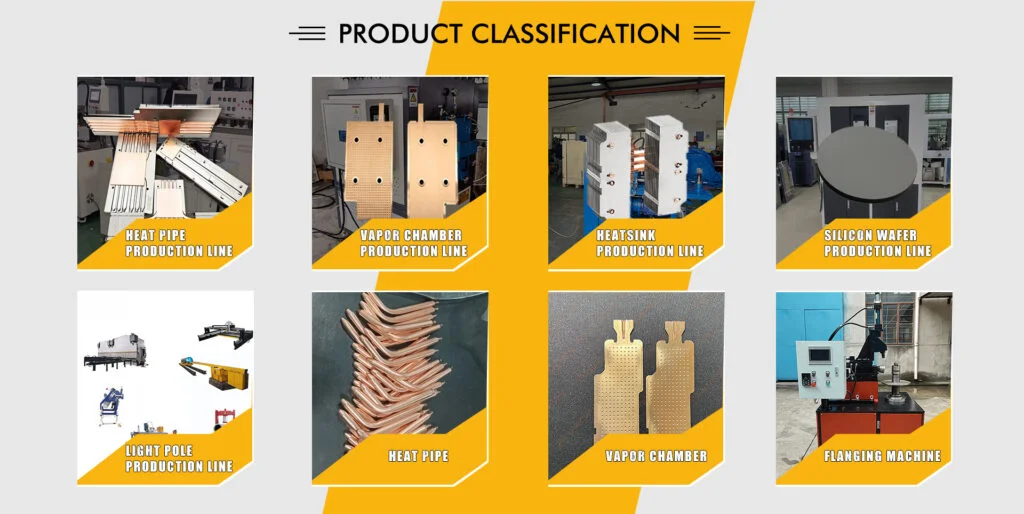
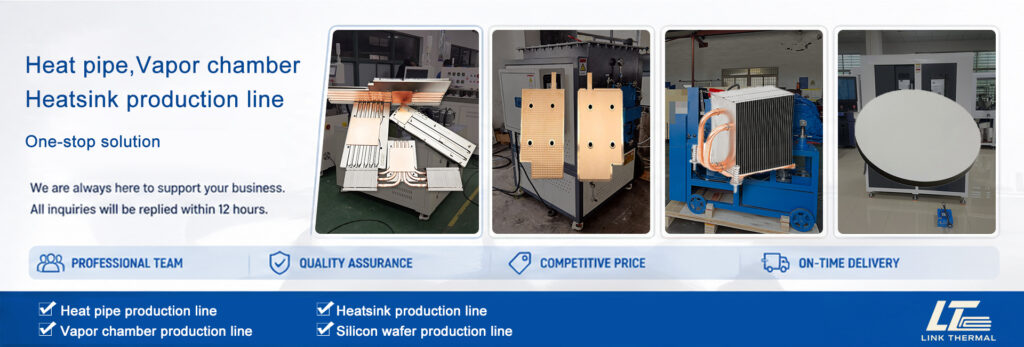
Bangwin Machine offers complete production lines tailored to your needs. Click to see the system here 【Vapor Chamber Production Line】
Each step of vapor chamber production affects the final product quality.
Wick fabrication, for example, needs precise powder filling and sintering.
Heat seal welding also requires high precision to prevent leaks.
Furthermore, the vacuum processing stage must be carefully controlled.
Because of this, manufacturers should seek an integrated production solution.
14. Why Choose Bangwin Machine?
Producing vapor chambers requires precision manufacturing techniques.
As such, choosing the right production equipment is vital.
Bangwin Machine is a thermal machine manufacturer that offers custom production lines.
We provide thermal manufacturing equipment for heat sink production, heat pipes, vapor chambers, and thermal assembly.
Bangwin Machine can help you with every step of the production process.
Clients can receive support starting from the planning stage and continue all the way to production and commissioning.
The planning stage may include analysis of the product and processes.
Next, engineers can help suggest suitable machinery.
Finally, vendors can work with you to create a unified production line.
The production line can include equipment procurement, installation, commissioning, testing, and even after-sales technical support.
Providing customers with comprehensive production support allows Bangwin Machine to ensure manufacturers can create stable vapor chamber production capacities.
Bangwin offers several useful production lines and machines for customers working with vapor chambers.
Home
15. FAQ
Q:What is a vapor chamber heatsink?
A vapor chamber heatsink is a heatsink that uses a vapor chamber to spread heat.
First, the vapor chamber spreads heat across a larger area.
Next, the heatsink’s fins dissipate heat into the surrounding air.
Q:How do vapor chamber heatsinks work?
Inside the vapor chamber is a working fluid.
As heat enters the chamber, the fluid evaporates and travels toward a cooler area.
A wick structure then returns the fluid to the heat source.
The video below demonstrates vapor chamber technology.
Q:Are vapor chamber heatsinks better?
Vapor chamber heatsinks allow for better heat spreading.
However, they may not always be the best thermal solution.
Traditional heat sinks without vapor chambers can be used in low heat flux situations.
Q: What is the difference between a vapor chamber and a heat pipe?
Heat pipes mainly transfer heat in one direction.
A vapor chamber spreads heat in a two-dimensional area.
Due to this, vapor chambers work well with high heat fluxes from a small source.
Q:What material is used for vapor chambers?
Copper is a popular material for vapor chambers.
However, copper vapor chambers can be used with aluminum fin stacks.
Q:Do vapor chamber heatsinks work on GPUs?
Yes. Vapor chambers are great for GPU because of their heat spreading capabilities.
Q:Will vapor chamber heatsinks work on servers?
Servers generate a lot of heat.
Vapor chamber heatsinks can help spread and dissipate heat from servers.
Q:How do you make a vapor chamber?
Vapor chamber production includes chamber forming, wick manufacture, sintering, fluid filling, vacuum, sealing, fixture, fin stacking, and testing.
Q: What kind of equipment is needed to make vapor chambers?
Equipment you may need includes powder filling machines, sintering furnaces,vacuum machines, welding machines, leak detectors, and thermal testers.
Q: Can Bangwin Machine supply vapor chamber production equipment?
Bangwin Machine can help you build your vapor chamber production line.
We are experienced in heat sink, heat pipe, and vapor chamber production equipment.
16. Conclusion
Vapor chamber heatsinks spread heat well.
The vapor chamber transfers heat to a heatsink which conducts heat to fins.
The heatsink’s fins then cool the device by dissipating heat.
Vapor chamber heatsinks are used for CPU cooling, GPU cooling, servers, and much more.
The manufacturing process for vapor chambers is complicated.
From wick formation to leak testing, each step impacts the vapor chamber’s performance.
As a result, manufacturers should invest in a proper production solution.
If you are looking for vapor chamber production equipment,
Bangwin Machine can offer custom machinery and production line solutions.
Please feel free to contact us for a quote!
Bangwin Machine Thermal Manufacturing Solutions