1. What Do Heat Sink Manufacturers Do?
Heat sink manufacturers engineer and fabricate thermal solutions for electronics and industrial hardware.
Essentially, heat sink manufacturers turn raw materials into cooling devices. Aluminum and copper are the most popular raw materials for heat sink manufacturing.
Heat sinks themselves usually consist of a thermal base and attached cooling fins. Heat from the electronic component transfers into the base. The heat then dissipates through the fins into the surrounding air.
Heat sink manufacturers are essential to electronics thermal management solutions.
- Extruded heat sinks
- Skived fin heat sinks
- Bonded fin heat sinks
- Zipper fin heat sinks
- Pin fin heat sinks
- Copper heat sinks
- Aluminum heat sinks
- Heat pipe heat sinks
In addition, heat sink manufacturers can also integrate heat pipes or vapor chambers.
This allows customers to use heat pipes to develop advanced thermal management technologies.
2. Types of Heat Sink Manufacturers
Not all heat sink manufacturers offer the same service capabilities.
As a result, customers should know the different types of heat sink suppliers.
Standard Heat Sink Manufacturers
Standard heat sink manufacturers produce common heat sink profiles.
Products from these suppliers typically use traditional aluminum extrusion designs.
Consequently, standard heat sinks work well with projects that have known thermal needs.
Here are some examples of standard heat sinks:
- Straight-fin heat sinks
- U- shaped profiles
- T- shaped profiles
- LED heat sinks
Custom Heat Sink Manufacturers
Custom heat sink manufacturers can create heat sinks to your exact specifications.
You can customize the following aspects of your heat sink:
- Fin height
- Fin thickness
- Base thickness
- Mounting holes
- Profile dimensions
- Surface treatment
Therefore, custom heat sinks work best when you have specialized electronics that do not fit standard configurations.
High-Performance Heat Sink Manufacturers
High-performance heat sink manufacturers specialize in extreme thermal conditions.
Products from these suppliers typically use one or more of the following technologies:
- Copper heat sinks
- Skived fins
- Hybrid heat sinks
Due to this, their heat sinks work well with high-power electronic components. They also work with high-performance computing solutions.
3. Common Heat Sink Manufacturing Methods
The manufacturing method determines what heat sink designs a factory can produce.
Heat sink extrusion is one of the most popular methods for creating heat sinks.
During this process, a heat-up aluminum billet is pushed through a custom-shaped die.
As a result, the manufacturer can create extended heat sink profiles with integrated fins.
Benefits of this process include:
- Fast production rates
- Little deviation in dimensions
- Low waste
- Design flexibility
Click here to learn more about 【Heatsink Extrusion Profiles】.
Skiving
Skiving manufactures attach thin fins onto a base by cutting from a metal block.
As a result, skived heat sinks have some of the highest fin densities on the market.
This process is ideal for compact devices with large heat loads.
Click here to learn about a related topic: 【Skived Fin Heat Sink】.
CNC Machining
CNC machining offers the best control over your heat sink dimensions.
As a result, you can use CNC machining to create any type of heat sink that you can think of.
CNC machining is ideal for creating prototypes and specialty products.
Click here to learn more about 【Heat Sink CNC Machining】.
Bonded Fin Manufacturing
Bonded fin heat sinks create the fins independently from the base.
As a result, this process allows for the most design flexibility. You can use bonded fins for large heat sinks with custom fin layouts.
Click here to learn about a related topic: 【Bonded Fin Heat Sink】.
Die Casting
Aluminum die-casting creates detailed aluminum parts through a mold.
As a result, die-casting works well for high-volume products that require complex shapes.
However, the drawback of die-casting is that creating the tools can be expensive.
4. Heat Sink Materials
Heat sink material choice will affect your thermal performance.
Aluminum Heat Sinks
Aluminum is a very common heat sink material.
Benefits of aluminum include:
- Lightweight
- High thermal conductivity
- Corrosion resistant
- Excellent extrusion capabilities
- Low cost
As a result, aluminum is well suited for commercial products.
6063 aluminum is the most common alloy used for extruded heat sinks.
Click here to learn more about 【Aluminium Heat Sink Material】
Copper Heat Sinks
Copper has a higher thermal conductivity than aluminum.
As a result, copper is well suited for use in high heat flux applications.
However, copper is not as lightweight or cheap as aluminum.
Copper is typically used for high-performance heat sinks.
Click here to learn about a related topic: 【Copper Heat Sink】
Copper-Aluminum Hybrid Heat Sinks
Some heat sinks use both copper and aluminum in the same product.
For instance, some heat sinks use a copper base with aluminum fins.
As a result, you can use this hybrid method to balance performance and weight.
Heat pipes are another way to create a hybrid heat sink.
5. Custom Heat Sink Manufacturing
Custom heat sinks allow you to tailor your heat sink to your application’s requirements.
The custom heat sink design process usually begins with your requirements.
Your requirements may include:
- Thermal load
- Maximum Temperature
- Physical size constraints
- Airflow conditions
- Mounting requirements
- Intended production volume
The manufacturer then works to design you a heat sink that meets those needs.
They will typically look to optimize:
- Fin spacing and height
- Base thickness
- Material selection
- Thermal interface selection
- Mounting structures
As a result, working with a manufacturer to custom-design your heat sink can greatly increase thermal and mechanical performance.
6. Heat Sink Manufacturing Process
The heat sink manufacturing process involves several key steps.
Step 1: Product Design
The engineer begins by identifying thermal and mechanical requirements for the product.
Step 2: Material Selection
Next, the manufacturer determines whether to use aluminum, copper, or another material.
Step 3: Forming
The manufacturer then forms the heat sink using extrusion, skiving, machining, or die-casting.
Step 4: Cutting
The factory then cuts the heat sink down to the desired size.
Step 5: CNC Machining
The manufacturer drills any mounting holes and other details with a CNC machining center.
Step 6: Surface Treatment
Next, the manufacturer may anodize or perform other finishing steps.
Step 7: Assembly
Additional components like heat pipes, clips, or fans get attached during assembly.
Click here to learn about 【Heat Sink Assembly Machine】.
Step 8: Quality Testing
Finally, the manufacturer runs the heat sink through a series of quality assurance tests. These tests include:
- Physical dimensions
- Flatness
- Fin height and spacing
- Surface scratches and burrs
- Expected thermal performance
Therefore, quality control plays a vital role in the manufacturing process.
7. How Manufacturers Control Heat Sink Quality
Heat sink manufacturers can ensure their products meet specifications using these quality control steps.
Dimensional Inspection
Manufacturers should check the following dimensions:
- Length
- Width
- Height
- Fin spacing
- Base thickness
As a result, customers know their product meets engineering requirements.
Flatness Inspection
The base of the heat sink should also have acceptable flatness.
Otherwise, the heat sink will not sit flush against the heat-generating component.
Material Inspection
Manufacturer should review the material certifications when the material arrives.
This ensures that the finished product has consistent material properties.
Thermal Testing
If the customer requests, manufacturers can perform thermal testing.
As a result, they can compare the measured thermal performance to the design goals.
Surface Inspection
Finally, manufacturers should check the product for:
- Scratches
- Oxidation
- Burrs
- Poorly applied coatings
Therefore, your heat sinks should have an aesthetically pleasing finish.
8. How to Choose Heat Sink Manufacturers
Selecting suppliers based on price is not a wise decision.
First of all, verify the manufacturer’s manufacturing capability.
Manufacturers have different available technologies. Check if they have the following capabilities:
Extrusion
CNC machining
Skiving
Fin bonding
Heat pipe assembly
Vapor chamber integration
This way you’ll know if the supplier can accommodate future products.
Next, you should verify the manufacturer’s customization capability.
Can they produce custom heat sinks?
Ask if the manufacturer can do the following:
Custom extrusion dies
Prototype production
Fin tuning
Material optimization
Surface treatment
Now customization will be a piece of cake.
You should also verify the manufacturer’s production capacity.
If you need to place large volume orders this will be essential.
Ask about the quantity of the following:
Equipment
Production lines
Automation
Quality control
Delivery capacity
Finally, consider the technical support the supplier can provide.
Heat dissipation products generally require technical knowledge.
As a result, the heat sink supplier should understand:
Thermal resistance
Heat flux
Airflow
Material selection
Fin structures
If the supplier has enough technical expertise they can help you further optimize your design.
9. Heat Sink Applications
Heat sink manufacturers provide products and services to a variety of industries.
Computers and GPUs
Computer processors and graphics cards (GPUs) produce a lot of heat.
As a result, heat sink manufacturers create efficient heat dissipation structures to cool these components.
High-end heat sinks use aluminum, copper, heat pipes, and vapor chambers to maximize heat transfer.
Click here to learn more about 【Vapor Chamber for GPU Cooling】.
LED Lighting
LED lights produce heat continually.
As a result, aluminum extrusion is commonly used for LED heat sinks.
Power Electronics
Power electronic products usually experience high thermal concentration.
Products that need heat sinks for power electronics include:
Inverter
Motor controller
Power supply
Industrial drive
Therefore heat sinks are crucial for these products’ stable operation.
Electric Vehicles
Electric vehicles use multiple power electronic components.
As a result, thermal management is critical in electric vehicles.
Heat sinks are commonly used in the following electric vehicle components:
Inverter
Charger
DC-DC converter
Control module
Data Centers
Data centers have many high-performance computers which produce heat.
As a result, data center cooling systems are beginning to use heat pipes, vapor chambers, and other cooling tech.
Heat sinks are commonly used in air cooled products.
High-density heat exchangers may use heat sinks in combination with heat pipes, vapor chambers, or liquid cooling.
10. Heat Sink Manufacturing Equipment
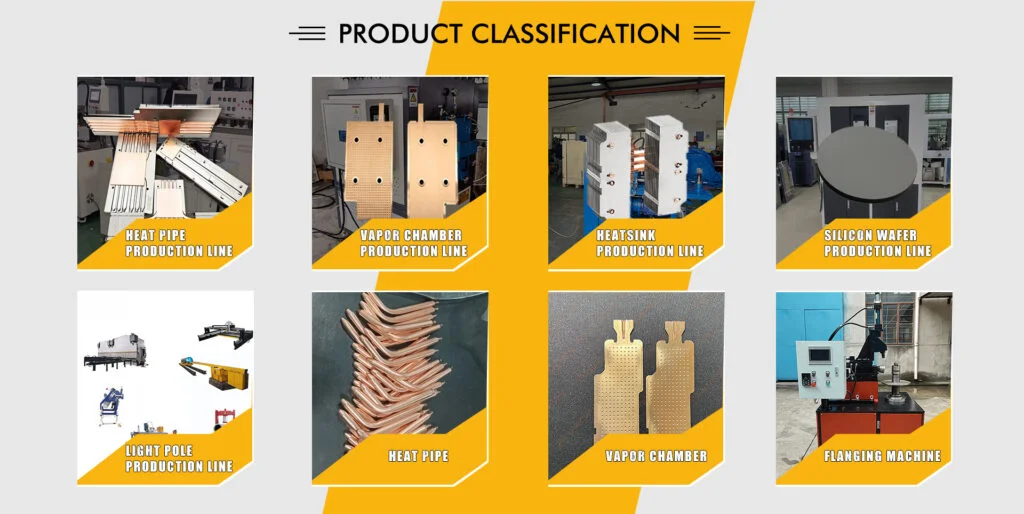
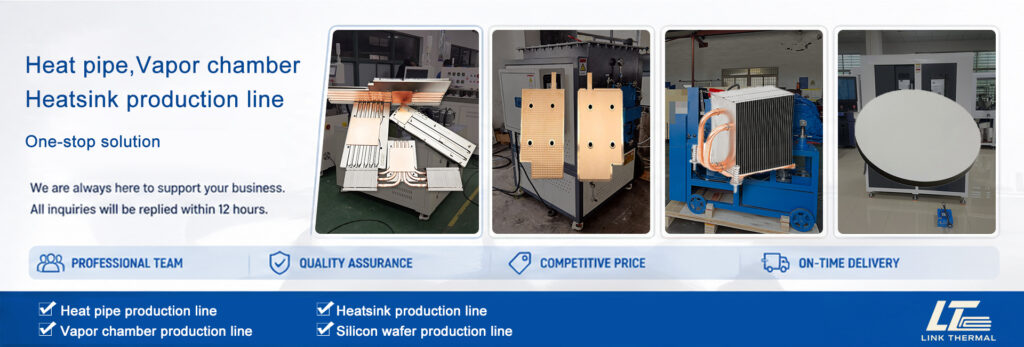
There are several machines that a professional heat sink production line can use.
The list below shows you some of these machines.
Aluminum extrusion machine
Heat sink fin cutting machine
CNC machining machine
Cutting machine
Heat pipe assembly machine
Heat sink assembly machine
Inspection machine
As a result, heat sink production lines use a variety of forming, machining, and assembly equipment.
You can learn about a complete 【Heat Sink Manufacturing Line】 to improve manufacturing efficiency.
Additionally, for automated heat sink production there are:
【Automated Heatsink Assembly Line】
Manufacturers can decrease human contact by using the automated heat sink production method.
Automated equipment can also ensure products have little to no variation.
11. Why Choose Bangwin Machine?
Bangwin Machine specializes in thermal industry manufacturing equipment and production solutions.
Including equipment used for the production of:
Heat sinks
Heat pipes
Vapor chambers
Thermal component assembly
As a result, Bangwin Machine allows manufacturers to do more than just produce heat sinks.
Customers that purchase Bangwin Machine equipment can produce:
Fin processing
Heat sink machining
Heat pipe assembly
Vacuum processing
Thermal component assembly
Additionally, customers have the option of Bangwin creating customized production equipment.
As a result, you can customize your equipment to fit your specific thermal products.
For example, a manufacturer could purchase equipment to make a custom aluminum heat sink production line.
Another customer might want a automated heat pipe assembly line.
More advanced thermal manufacturers might need help producing vapor chambers.
Bangwin Machine is able to provide these solutions with their thermal manufacturing division.
Visit Bangwin Machine Thermal Machinery to see the wide range of thermal equipment and production solutions on offer.
If you are a company looking for heat sink manufacturers, the website also gives you heat sink technical knowledge. Such as information on heat sinks, heat pipes, vapor chambers, and thermal manufacturing.
Home
13. FAQ
- What are heat sink manufacturers?
Heat sink manufacturers design and produce thermal components that remove heat from electronic and industrial systems.
They may use extrusion, skiving, CNC machining, bonding, casting, and other technologies.
- Which material do heat sink manufacturers commonly use?
Aluminum remains one of the most common materials.
Copper also serves high-performance thermal applications.
Therefore, material selection depends on thermal and mechanical requirements.
- Can heat sink manufacturers produce custom designs?
Yes.
Many manufacturers develop custom profiles and thermal structures.
They can modify fin geometry, dimensions, mounting features, and materials.
- What is the most common heat sink manufacturing method?
Aluminum extrusion remains one of the most common methods.
It provides efficient production and consistent profile dimensions.
- How do I choose heat sink manufacturers?
Evaluate their manufacturing technologies, customization capability, production capacity, quality control, and engineering support.
Therefore, avoid selecting suppliers based only on price.
- Can heat sink manufacturers integrate heat pipes?
Yes.
Manufacturers can integrate heat pipes into aluminum or copper heat sinks.
Therefore, the resulting design can improve heat spreading.
- Do heat sink manufacturers produce vapor chamber systems?
Some thermal manufacturers also provide vapor chamber production equipment and assembly solutions.
Therefore, customers can develop more advanced thermal products.
- Does Bangwin Machine manufacture heat sinks?
Bangwin Machine focuses primarily on thermal manufacturing equipment and production solutions.
Its equipment supports heat sinks, heat pipes, vapor chambers, and related thermal components.
14. Conclusion
Picking the right heat sink manufacturers is important.
It’ll affect your product’s performance, price, and lifetime reliability.
Heat sink manufacturers should have the capability to produce your heat sink.
Aluminum extrusion is a popular method for high-volume heat sink production.
Skived heat sinks and CNC machined heat sinks allow for more specialized heat sinks to be made.
Copper is another material that provides great thermal performance.
Heat pipes and vapor chambers are also great at spreading heat.
AI, GPUs, electric vehicles, industrial electronics, and data centers are always improving.
As a result, these industries will require better thermal management solutions.
Heat sink manufacturers should have the right equipment to produce their thermal products.
Bangwin Machine is here to provide those thermal manufacturing solutions.
Check out Bangwin Machine – Thermal Manufacturing Equipment for more information:
https://bangwinmachine.com/thermal-manufacturing-equipment