1. What Is an Industrial Heat Sink?
An industrial heat sink is used to thermally cool industrial electronics and mechanical equipment.
Since industrial equipment usually runs 24/7,
they can produce significant amounts of heat.
Such as:
- Power converters
- Motor drives
- Industrial controllers
- Inverters
- Welding systems
- Automation controls
- Telecommunications equipment
- Solar inverters, etc.
An industrial heat sink helps dissipate heat away from these components.
It typically consists of a thermally conductive base which makes contact with the heat source.
And cooling fins which help dissipate heat into the surrounding air.
Thus, heat will travel from the source to the base and through the fins into the air.
Industrial heat sinks normally need to be more robust and thermally effective.
So manufacturers may use aluminum, copper, heat pipes or create hybrid solutions.
2. How Does an Industrial Heat Sink Work?
Industrial heat sinks use thermal conduction and thermal convection to dissipate heat.
An electronic component will produce heat as it operates.
This heat transfers into the heat sink at the mounting point.
Then, the heat will spread throughout the metal base.
Finally, heat will transfer into the surrounding air via cooling fins.
As a result, three main things determine performance:
- Thermal conductivity
- Heat transfer area
- Airflow
Aluminum offers a good balance of thermal conductivity and weight.
Copper on the other hand has even better thermal conductivity.
So heat sink material is chosen based on thermal requirements.
Industrial equipment can use a fan or blower to force air through the heat sink.
As forced airflow improves heat transfer, forced air heat sinks can dissipate more heat.
3. Why Industrial Equipment Needs Heat Sinks
Industrial equipment often has demanding operating conditions.
Equipment may run for many hours without stopping.
Or they may have to operate in hot/dusty environments.
As a result, thermal management is critical for reliable operation.
A properly selected industrial heat sink can:
- Lower component temperatures
- Improve equipment reliability
- Reduce thermal stress
- Lengthen component lifespan
- Ensure equipment operates efficiently
For instance, industrial inverters can produce a lot of heat.
So you may see a large extruded aluminum heat sink attached to the enclosure.
Motor drives can also require high-performance heat sinks.
As you can see, heat sinks are very important for industrial power electronics.
4. Types of Industrial Heat Sinks
Just as there are many types of electronics, there are many types of heat sinks.
Let’s take a look at some common industrial heat sink designs.
Extruded Aluminum Heat Sink
Heat sink extrusion is one of the most common industrial heat sink technologies.
A heated aluminum billet is pushed through a custom die.
Resulting in a continuous heat sink profile being manufactured.
You can get extruded heat sinks with:
- Straight fins
- High-density fins
- U-Fins
- T-Fins
- Custom mounting features, etc.
Click here to learn more about 【Heatsink Extrusion Profiles】
Skived Fin Heat Sink
Skived heat sinks have thin fins that are sliced directly from a metal block.
Therefore, very dense fin structures can be manufactured.
This makes skived heat sinks ideal for space constrained industrial electronics.
Click here to learn more about 【Skived Fin Heat Sink】
Bonded Fin Heat Sink
Individual fins are manufactured and attached to a base plate.
Bonded heat sinks allow for great flexibility in fin configurations.
Click here to learn more about 【Bonded Fin Heat Sink】
Copper Heat Sink
Copper heat sinks have the best thermal conductivity of any metal.
Therefore, copper is ideal for industrial applications with high heat flux.
However, copper is also much heavier than aluminum.
As a result, you have to take weight and cost into consideration.
Click here to learn more about 【Copper Heat Sink】
Heat Pipe Heat Sink
Heat pipes allow for better heat spreading.
They are ideal to use with heat sources that have high heat flux in a small area.
A heat pipe will absorb heat from one end and travel to another location with larger fins.
Click here to learn more about 【Heat Pipe Production Line】
5. Industrial Heat Sink Materials
The material you choose will affect your heat sink’s performance.
Aluminum
Aluminum is by far the most used material for industrial heat sinks.
Aluminum offers:
- Excellent thermal conductivity
- Low density
- Corrosion resistance
- Superb extrusion capabilities
- Reasonable price
Therefore, aluminum is used in many industrial applications.
6063 aluminum is commonly used for heat sink extrusions.
6061 aluminum has higher mechanical strength but lower thermal conductivity.
Click here to learn the differences between 【Aluminium Heat Sink Material】
Copper
Copper has a higher thermal conductivity than aluminum.
Therefore, copper is used in high-performance industrial heat sinks.
The problem is that copper has a higher density and is more expensive.
As a result, you typically only see copper heat sinks used in high heat flux applications.
Copper-Aluminum Hybrids
These heat sinks use both copper and aluminum in the heat sink.
Such as a copper base with aluminum fins.
By combining these two materials you get the benefits of both.
6. Industrial Heat Sink Design Factors
There are several things you should consider when designing a heat sink.
Heat Load
How much heat does the component produce?
A heat sink for higher heat loads will be larger.
Thus, heat load is the first thing you should consider when choosing a heat sink.
Fin Design
The heat transfer area is controlled by the fin design.
Fin design includes:
- Fin height
- Fin thickness
- Fin spacing
- Fin density
- Fin length
As you can see, many variables go into the fin design.
Airflow
Heat sinks can use natural convection or forced-air(convection).
Natural convection heat sinks require a larger surface area.
While adding a fan allows a heat sink to dissipate more heat.
As a result, airflow is a big consideration when choosing a heat sink.
Installation Environment
Heat sinks for industrial equipment have limited space.
As a result, the heat sink must fit into the space provided.
Take note of the height, width, length, mounting holes, cable clearance, etc.
Environmental Conditions
Heat sinks may be exposed to dust, moisture, vibration, chemicals, etc.
Therefore, you may need heat sinks with special coatings or stronger heat sinks.
7. Industrial Heat Sink Manufacturing Process
The manufacturing process will vary based on the type of heat sink.
However, here is a generalized process that most heat sinks will go through.
Step 1: Design
The engineers will figure out:
- Heat load
- Physical dimensions
- Material
- Airflow requirements
- Mounting details, etc.
As a result, the heat sink design is based on thermal and mechanical requirements.
Step 2: Material Preparation
The manufacturer will cut up sheets of aluminum or copper.
Step 3: Forming
The manufacturer forms the heat sink to the desired shape.
Common industrial heat sink manufacturing processes include:
- Extrusion
- Skiving
- CNC machining
- Bonding
- Die casting
Step 4: Cutting
Profiles will be cut to the desired dimensions.
Step 5: CNC Machining
Mounting holes and other precision features will be CNC machined.
Click here to learn more about 【Heat Sink CNC Machining】
Step 6: Surface Treatment
Heat sinks can undergo anodizing or other surface treatments.
As a result, this will improve the heat sinks durability and appearance.
Step 7: Assembly
Some heat sinks will have additional components such as:
- Heat pipes
- Fan
- Thermal pad
- Mounting clips
Click here to learn more about 【Heat Sink Assembly Machine】
Step 8: Testing
Finally, the manufacturer will test the heat sink to ensure quality.
8.Industrial Heat Sink Applications
An industrial heat sink can provide cooling benefits for many types of applications. Let’s examine some of the different areas where industrial heat sinks are commonly used.
Industrial Inverters
An inverter is an electrical circuit or device that changes the characteristics of electrical power.
The power semiconductors used in inverters will generate heat as current flows through them.
Industrial heat sinks help dissipate that heat to maintain a stable temperature.
Motor Drives
Motor drives are devices that control industrial motors.
Industrial motor drives may run continuously for long periods of time.
Effective thermal management helps ensure long-term reliability in these devices.
Welding Equipment
Welding machines can produce significant amounts of electrical heat.
Heat sinks are used to cool the power electronics in these devices.
Industrial Power Supplies
Industrial power supplies may need to handle large electrical loads.
As a result, reliable cooling is required to prevent the power supply from overheating.
Solar Inverters
Solar inverters are used in solar power systems.
Like other power electronic systems, solar inverters require effective thermal management to ensure reliable operation.
EV Charging Equipment
Electric vehicle chargers contain high-power electronic components.
It is necessary to use heat sinks or other methods to effectively cool these components.
Heat sinks can be used to cool all sorts of industrial electronics, such as:
- Power modules
- Rectifiers
- Switching devices
- Control electronics
Telecommunications Equipment
Telecom equipment can often operate 24/7.
9.Industrial Heat Sink vs Standard Heat Sink
Feature | Industrial Heat Sink | Standard Heat Sink |
Operating Time | Often continuous | Variable |
Heat Load | Medium to high | Low to medium |
Structure | Robust | General |
Environment | More demanding | Controlled |
Customization | Often high | Moderate |
Thermal Design | Application-specific | Standardized |
A practical example would be an industrial inverter. This may require a custom aluminum extrusion heat sink design.
On the other hand, a consumer electronics product would typically use a standard off-the-shelf heat sink profile.
10.How to Choose an Industrial Heat Sink
Here are some factors to consider when choosing the right industrial heat sink.
Determine Heat Output
First, determine the thermal load of the component.
You can use this information to calculate the required thermal resistance of the heat sink.
Check Airflow
Decide if the system will use natural convection or forced air cooling.
You can choose the appropriate fin design based on the cooling method.
Select Material
Aluminum offers low weight and cost-effective thermal performance.
Copper offers better thermal conductivity at a higher price.
Consider using a hybrid heat sink if both properties are important for your design.
Check Dimensions
Double-check that the heat sink will fit into the available space.
Evaluate Environment
Take note of the following environmental factors
- Temperature
- Humidity
- Dust
- Vibration
- Corrosive chemicals/materials
The heat sink should be designed to withstand the conditions present in the device’s operating environment.
Consider Production Volume
High-volume industrial heat sinks are usually produced with extrusion machines.
Low-volume or custom heat sinks are usually CNC machined.
The manufacturing method you choose will affect the unit cost of your heat sinks.
11.Industrial Heat Sink Manufacturing Equipment
The following cooling products equipment can be used to create industrial heat sinks:
- Aluminum extrusion machine
- Extrusion dies
- Heat sink cutter
- Fin processing machine
- CNC machining centers
- Heat sink surface treatment equipment
- Heat pipe assembly machine
- Automated heat sink assembly machine
- Inspection equipment
With the right equipment, an industrial manufacturer can create a custom production workflow.
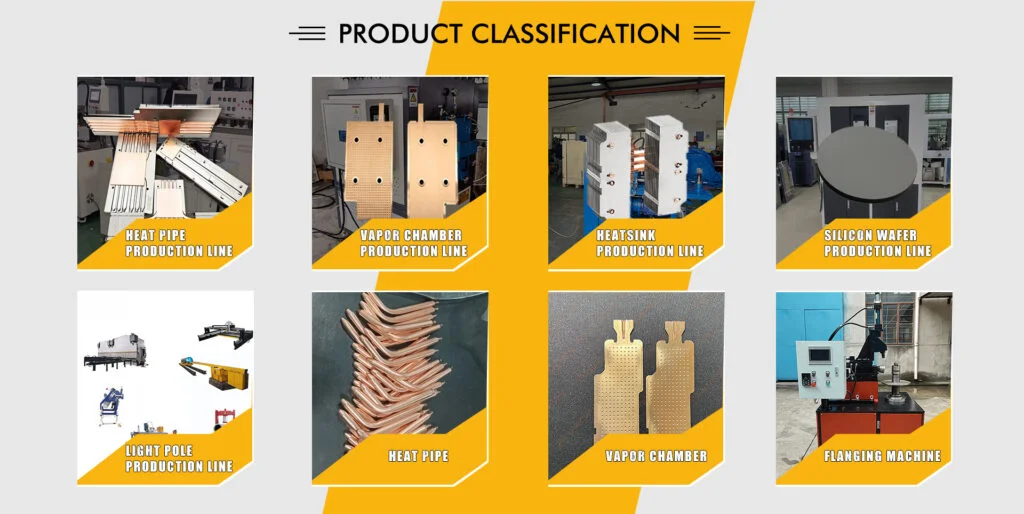
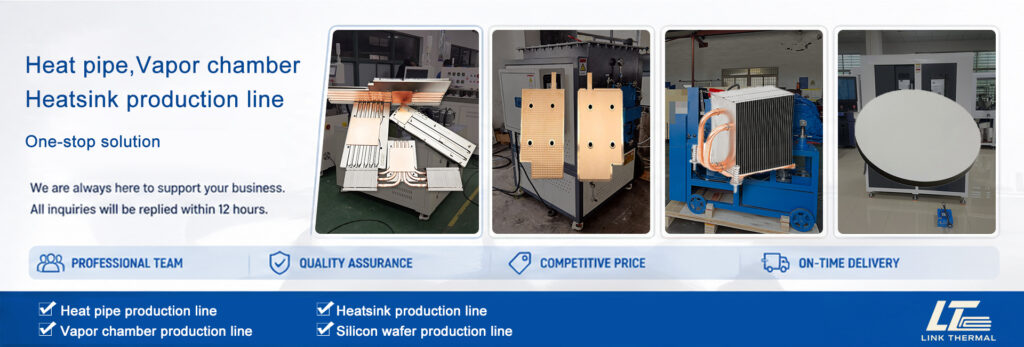
For example, a 【Heat Sink Manufacturing Line】 could include several (or all) of the processes above.
Additionally, certain pieces of equipment like automated assembly machines can ensure consistent production results.
Advanced cooling products manufacturers may also require a:
【 Vapor Chamber Production Line 】
Vapor chambers are used to improve heat spreading performance in high power electronics.
12.Why Choose Bangwin Machine?
Bangwin Machine is a thermal manufacturing equipment supplier that offers complete production solutions.
The company can provide machinery for companies that manufacture:
- Industrial heat sinks
- Aluminum heat sinks
- Copper heat sinks
- Heat pipes
- Vapor chambers
- Thermal assemblies
Bangwin Machine also offers customized thermal equipment solutions.
Customers have the option of working with Bangwin Machine to develop their own production line based around their heat sinks or other thermal products.
For instance, some customers may need custom fin processing machinery.
Others might require automated heat sink assembly equipment.
Advanced thermal products manufacturers may need a custom vapor chamber production line.
Bangwin Machine can provide all of these solutions. Learn more about the company’s offerings at:
Bangwin Machine Thermal Manufacturing Solutions
This page contains more technical details about heat sink manufacturing, heat pipes, vapor chambers, and thermal equipment.
Home
14. FAQ
- What is an industrial heat sink?
An industrial heat sink removes heat from industrial electronic components.
It usually combines a thermally conductive base with cooling fins.
Therefore, it helps maintain safe operating temperatures.
- What material works best for industrial heat sinks?
Aluminum works well for many industrial applications.
Copper provides higher thermal conductivity for demanding applications.
Therefore, engineers should select the material according to thermal requirements.
- Are aluminum heat sinks suitable for industrial equipment?
Yes.
Aluminum offers low weight, good thermal conductivity, and excellent extrusion performance.
Therefore, it suits many industrial applications.
- When should I choose a copper industrial heat sink?
Choose copper when the application requires high thermal conductivity or strong heat spreading.
However, consider the additional weight and cost.
- Can industrial heat sinks use heat pipes?
Yes.
Heat pipes can transfer heat from concentrated sources to larger fin areas.
Therefore, they can improve thermal performance.
- Can Bangwin Machine provide industrial heat sink equipment?
Yes.
Bangwin Machine provides thermal manufacturing equipment and customized production solutions.
Its solutions cover heat sinks, heat pipes, vapor chambers, and related thermal components.
Conclusion
Industrial heat sinks play a key role in many industrial electronics devices. They keep power semiconductors, motor drives, and other components from overheating.
When choosing the right industrial heat sink, several factors need to be considered.
The heat sink material greatly affects thermal performance and weight.
Aluminum heat sinks provide an ideal balance of thermal conductivity and lightweight properties.
Copper heat sinks are better suited for high-performance applications that require strong heat spreading.
Heat pipes and vapor chambers can also be used to improve heat spreading performance in industrial heat sinks.
As technology continues to advance, thermal management will only become more important.
Whether it’s for industrial machinery, EV’s, or AI computers – we’ll need heat sinks to keep electronics from overheating.
Bangwin Machine is here to help thermal manufacturers with their heat sink production needs.
Check out Bangwin Machine’s website to find out more about their thermal manufacturing equipment:
Bangwin Machine