1. What Is a Heat Sink?
Before revealing all heat sink types, let’s answer: what is a heat sink?
Essentially, a heat sink is a thermal management device that extracts heat from another device.
Heat sinks absorb heat generated by electronic or mechanical equipment. They then transfer heat into the surrounding air.
As a result, heat sinks prevent electronics from reaching unsafe temperatures.
Heat sinks usually feature a base and multiple fins protruding from it.
The base contacts the heat generating source.
The fins, however, provide extra surface area for heat transfer.
Air flowing over the fin surface removes heat from the sink.
So the basic heat transfer path looks like this:
Heat Generating Source → Heat Sink Base → Fins → Air
Many different heat sink structures exist for different applications.
So let’s examine each heat sink type in more detail.
A complete list of heat sink types include:
- Extruded heat sinks
- Skived fin heat sinks
- Bonded fin heat sinks
- Stamped heat sinks
- Die cast heat sinks
- CNC machined heat sinks
- Heat pipe heat sinks
- Vapor chamber heat sinks
Remember that each heat sink type offers unique pros and cons.
So choose your heat sink based on material, heat load, airflow, space constraints, and production volume.
For a simple heat sink introduction, check out 【 What Is a Heat Sink 】.
2. Why Are There Different Heat Sink Types?
Different electronics produce different amounts of heat.
Electronics also have different spaces available for installation.
As a result, you cannot use the same heat sink for every situation.
Take industrial machines for example; these may require large aluminum extrusions.
On the other hand, small electronics may have very little space for a heat sink.
Small electronics benefit from thin, dense heat sink fins.
High-power CPUs and GPUs may need heat pipes or vapor chambers.
As a result, you should choose a heat sink that fits your thermal and mechanical needs.
Key design considerations include:
- Heat load
- Thermal resistance
- Fin density
- Airflow
- Available space
- Material
- Weight
- Manufacturing cost
- Production volume
As a result of these factors, there are many variations of heat sink types.
3. Main Heat Sink Types
Here are the main heat sink types.
Heat Sink Type | Main Advantage | Typical Application |
Extruded | Low cost and scalable production | Industrial electronics |
Skived Fin | High fin density | High-performance electronics |
Bonded Fin | Flexible fin design | Large cooling systems |
Stamped | Low-cost mass production | Consumer electronics |
Die Cast | Complex structures | Automotive and industrial |
CNC Machined | High precision | Custom thermal parts |
Heat Pipe | Excellent heat spreading | CPU and GPU cooling |
Vapor Chamber | Advanced heat spreading | High-power electronics |
Compare each heat sink types’ thermal performance and manufacturing capabilities.
4. Extruded Heat Sink
Extruded heat sinks are some of the most popular heat sink types.
Production involves pushing aluminum through a die with the desired cross-section.
As a result, the resulting aluminum profile has a constant cross-section with the length of the material strip.
This profile can include fins, mounting tabs, and integrated heat pipes.
Typical extrusion materials are aluminum alloys such as 6063.
Extruded heat sinks are relatively lightweight and low-cost.
Advantages of extruded heat sinks:
- Low production cost
- High production efficiency
- Lightweight
- Decent thermal performance
- Flexible profile designs
- Excellent production scalability
As a result, extruded heat sinks are perfect for high-volume production.
Learn more about extruded heat sinks and heatsink extrusion profiles .
5. Skived Fin Heat Sink
Skived fin heat sinks are similar to extruded heat sinks.
The manufacturing process involves cutting thin fins from a metal block.
As a result, the machine skives or slices thin pieces from the parent metal block.
Skived heat sinks can create extremely thin and closely spaced fins.
Small fin spacing allows for a high heat transfer surface area.
Resultantly, skived fin heat sinks are ideal for high-performance applications.
Skiving works with aluminum and copper.
Copper skived fins have higher thermal conductivity.
Aluminum provides a lighter weight alternative than copper.
Advantages of skived fin heat sinks:
- High fin density
- Very thin fins
- Excellent heat transfer surface area
- Strong connection between fins and base
- No need for separate fin bonding
As a result, skived fins are ideal for compact heat sinks.
Learn more about skived fin heat sinks.
6. Bonded Fin Heat Sink
Bonded fin heat sinks use discrete fins connected to a base.
Manufacturers can produce the fins independently of the base.
They can then join the fins to the base with an appropriate process.
Bonded fin heat sinks allow for a great deal of design flexibility.
Designers can set the height and spacing of fins at will.
Bonded fin heat sinks also allow for large heat transfer surfaces.
Advantages of bonded fin heat sinks:
- Very flexible fin geometry
- Can create large surface areas
- Ideal for large heat sinks
- Can customize fin spacing
- High design flexibility
As a result, bonded fins are useful for custom industrial heat sinks.
Learn more about bonded fin heat sinks.
7. Stamped Heat Sink
Stamped heat sinks are another common heat sink type.
These manufacturing processes form sheets of metal into the desired shape.
Production involves cutting and bending thin sheets of metal.
As a result, stamping supports high production volumes with low tooling costs.
Stamped heat sinks generally use aluminum or copper.
Stamped heat sinks typically have mounting tabs and fins.
Advantages of stamped heat sinks:
- Low tooling costs for high production volumes
- Fast
- Lightweight
- Ideal for products made from thin metal
- Products are highly repeatable
As a result, stamped heat sinks are ideal for mass-production applications.
Stamping cannot typically produce as intricate fin designs as extrusion or skiving.
8. Die Cast Heat Sink
Die casting involves pouring liquid metal into a mold.
As a result, you can create intricate 3D structures with die-casting.
Three common features of die-cast heat sinks include:
- Mounting points
- Fins
- Ribs
You can integrate many useful structures into a single die-cast block.
As a result, die cast heat sinks can serve both thermal and mechanical functions.
Common die casting materials include aluminum.
Automotive and industrial electronics often use die cast heat sinks.
Advantages of die cast heat sinks:
- Intricate, complex geometries
- Integrate mounting structures into heat sink
- High production efficiency
- Cast parts have high mechanical strength
As a result, die casting is ideal if your heat sink needs to serve other mechanical purposes.
9. CNC Machined Heat Sink
CNC machining mills parts out of solid blocks of metal.
As a result, CNC machining can produce extremely precise heat sinks.
Features that machining can produce include:
- Custom fin arrangements
- Mounting holes
- Precision grooves
- Flat surfaces
- Heat pipe channels
As a result, CNC machining is great for prototype and custom products.
CNC Machining is ideal for low to medium volume production.
Machined heat sinks tend to cost more than extruded heat sinks.
For high volume production, extrusion is typically cheaper than machining.
Learn more about Heat Sink CNC Machining .
10. Heat Pipe Heat Sink
Heat pipe heat sinks feature heat pipes integrated with cooling fins.
Heat pipes conduct heat via evaporation and condensation.
As a result, heat pipes can spread heat away from concentrated heat sources.
The fins then dissipate heat into the surrounding environment.
Heat pipe heat sinks are ideal for:
- CPUs
- GPUs
- Gaming PCs
- Telecom equipment
- Industrial electronics
- High-performance computing
As a result, heat pipe heat sinks provide greater heat spreading capability than simple metal conduction.
11. Vapor Chamber Heat Sink
Vapor chamber heat sinks use a flat, two-phase heat spreading structure.
Operating similarly to heat pipes, vapor chambers differ by spreading heat over a larger area.
As a result, vapor chambers handle concentrated heat sources extremely well.
Examples of common applications include:
- GPUs
- CPUs
- AI servers
- Data centers
- Gaming devices
- High-performance electronics
Vapor chambers can also be paired with fin stacks.
As a result, the combination can provide efficient heat spreading and cooling.
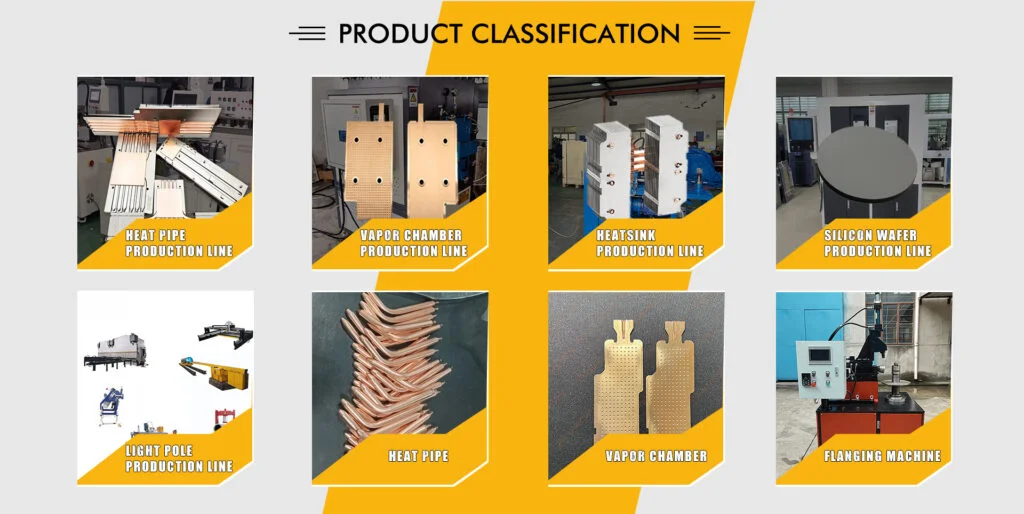
【 Vapor Chamber Production Line 】
12. Copper vs Aluminium Heat Sinks
Heat sink material has a large impact on thermal performance.
Copper has a higher thermal conductivity.
As a result, copper can spread heat more effectively.
However, copper also has a much higher density than aluminum.
Consequently, copper heat sinks are heavier.
Aluminum offers benefits like lighter weight and cheaper material cost.
Additionally, aluminum has great extrusion capabilities.
As a result, aluminum is the preferred material for most heat sinks used today.
As a result, engineers must consider the entire thermal system when choosing heat sink material.
【 Copper vs Aluminium Heatsink 】
13. How to Choose the Right Heat Sink
When trying to decide on which heat sink to use, there are some things you should consider.
Step 1: Determine your heat load
Heat load is determined by calculating the heat output of the component.
As a result, you will know how much cooling is needed.
Step 2: Evaluate airflow
Systems will use either natural or forced convection.
As a result, you will know how to design the fin structure.
Step 3: Check your installation space
Know the maximum length, width, and height allowances.
As a result, you can ensure the heat sink will fit your equipment.
Step 4: Select your material
Choose aluminum for lightweight and inexpensive heat sinks.
Choose copper when your design needs the best heat spreading.
As a result, the heat sink material you choose should meet your thermal requirements.
Step 5: Select your manufacturing method
Use extrusion for low-cost, high-volume production of standard heat sinks.
Use skiving when you need high fin-density.
Use CNC machining for custom heat sinks.
Use heat pipes to cool high heat flux loads.
As a result, you should choose a manufacturing method that meets your production needs.
Step 6: Consider production volume
High-volume productions will usually use extrusion or stamping.
Low-volume, customized products will favor CNC machining or skiving.
As a result, choose a manufacturing method that makes sense financially.
14. Heat Sink Manufacturing Equipment
Heat sinks can be manufactured using various methods and production equipment.
A full heat sink production system can include:
- Aluminum extrusion machines
- Heat sink cutting machines
- Fin processing machines
- CNC machining centers
- Heat pipe assembly machines
- Surface treatment machines
- Automated assembly machines
- Thermal testing machines
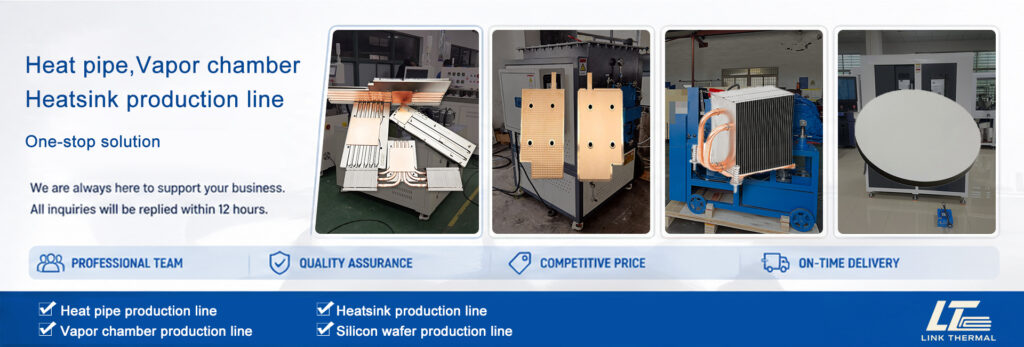
For example, a Bangwin 【 Heat Sink Manufacturing Line 】 can include several different pieces of equipment.
Fin processing can be handled by a 【 Heat Sink Fin Machine 】.
Heat sink assembly can be automated with a 【 Heat Sink Assembly Machine 】.
As a result, manufacturers can select the equipment that works with their heat sink designs.
Advanced heat sinks that use heat pipes or vapor chambers will require additional production equipment.
As a result, some heat sink production lines will be much more complex than others.
15. Why Choose Bangwin Machine?
At Bangwin Machine, we offer thermal production equipment as well as customized production solutions.
We specialize in:
- Heat sinks
- Heat pipes
- Vapor chambers
- Thermal assemblies
As a result, we can help you make just about any cooling product.
Our equipment covers these popular thermal manufacturing processes:
- Fin processing
- Heat sink assembly
- Heat pipe production
- Vacuum processing
- Powder filling
- Sintering
- Vapor chamber production
- Thermal testing
Additionally, we can offer custom production machinery to fit your needs.
As a result, you can have a heat sink manufacturing line completely built around your product.
For thermal production equipment and solutions, visit:
Bangwin Machine Thermal Machinery
Browse our website to learn more about our thermal manufacturing technologies, equipment, and customized production solutions.
Home
17. FAQ
l What are the different types of heat sinks?
The main categories include: extruded, skived, bonded, stamped, die-cast, CNC-machined, heat pipe, and vapor chamber heat sinks.
l Which type of heat sink should I use?
There isn’t a singular “best” heat sink. The application will determine your best thermal solution.
l What is the most commonly used heat sink material?
Aluminum is by far the most popular material used for heat sinks.
l Are copper heat sinks better than aluminum heat sinks?
Copper has a higher thermal conductivity than aluminum.
However, aluminum is much lighter and cheaper than copper.
l Which is better, extruded or skived heat sinks?
Extruded heat sinks are formed using a metal die.
Skived heat sinks are created by slicing thin fins off of a metal block.
l Why would I use a heat pipe heat sink?
Heat pipe heat sinks are great when heat sources are located near each other. The heat pipe helps spread the heat.
l Why would I use a vapor chamber heat sink?
Similar to heat pipes, vapor chamber heat sinks are also useful when your heat sources are close together.
l Can Bangwin Machine provide heat sink manufacturing equipment?
Yes! At Bangwin Machine, we provide customized heat sink production equipment.
18. Conclusion
There are many different heat sink designs and manufacturing methods to consider.
Extruded heat sinks can be produced quickly and in high volumes.
Skived heat sinks provide greater fin density than extruded designs.
Bonded heat sinks allow for more flexible fin arrangements.
CNC machining is ideal for precise, custom heat sinks.
Heat pipes and vapor chambers allow for effective heat spreading.
As a result, there is no definite “best heat sink.” It all depends on your application.
The material you choose can also make a big difference in performance.
Aluminum heat sinks are much lighter and cheaper than copper.
Copper heat sinks are better at spreading heat than aluminum ones.
As a result, you will need to consider all of these factors when comparing thermal solutions.
With so many new technologies emerging every day, thermal management is becoming more important than ever.
From AI computers to data centers to electric vehicles, efficient heat dissipation is critical to the success of these products.
Consequently, heat sink manufacturers will need reliable heat sink production equipment.
Bangwin Machine is here to provide that equipment.
Visit us at:
Bangwin Machine Thermal Machinery