Introduction
Modern electronic devices are shrinking and becoming more powerful.
But even so, higher performance means more heat.
Hence, thermal management becomes key.
Electronic components such as:
- CPUs
- GPUs
- Power modules
- LED systems
- Industrial controllers
generate heat during operation.
The heat sinks dissipates this heat to ensure that the device does not exceed safe operating temperatures.

Heat sinks are a thermal component that draws heat away from electronic components and into the surrounding environment.
It improves:
- Device reliability
- Operating stability
- Component lifespan
Bangwin Machine is a professional thermal manufacturing equipment as heat sink production line, heat pipe equipment, vapor chamber machine and various customize thermal solutions.
👉 Check immortalized thermal manufacturing website here — https://thermalmachinery.com/
What Is a Heat Sinks?
A heat sinks is a passive thermal expert.
Its working principle is to move heat away from the areas with the most heat generation.
- The basic working process includes:
- The electronic component produces heat.
- This heat conducted to the base of the heat sink.
- The fins spread the heat.
The heat is removed by air or liquid.
Heat sink act as a cooling agent and helps to avoid the heating.
A typical heat sinks contains:
- Base plate
- Cooling fins
- Heat pipes or vapor chambers
- Thermal interface materials
This design increases the efficiency of heating dissipation.
How Does a Heat Sink Work?
To understand how a heat sink works, the definition of a heat sinks must first be understood.
Thermal conduction and convection are the main use of heat sinks.
Step 1: Heat Absorption
The bottom of the heat sink, also called a base, directly touches the thermal source.
For example:
- CPU surface
- GPU chip
- Power semiconductor
So heat flows away from a component into the heatsink.
Step 2: Heat Distribution
The base distributes heat throughout the body.
Increased heat distribution due to the larger surface area.
As a result, the manufacturers design the heat sinks through optimized structures.
Step 3: Heat Dissipation
Heat that gets absorbed is dissipated through cooling fins
Convection is the removal of heat due to the motion of air.
Therefore, the component temperature decreases.
Heat Sink Main Components
There are several main parts of a heat sink.
Base Plate
Base plate — this is the part, which touch with a heat source.
It requires:
- Good thermal conductivity
- Flat surface
- Strong mechanical structure
Most common materials include copper and aluminum.
Cooling Fins
Cooling fins increase surface area.
Higher surface area provide better heat dissipation.
As a result, fin design has a direct impact on performance.
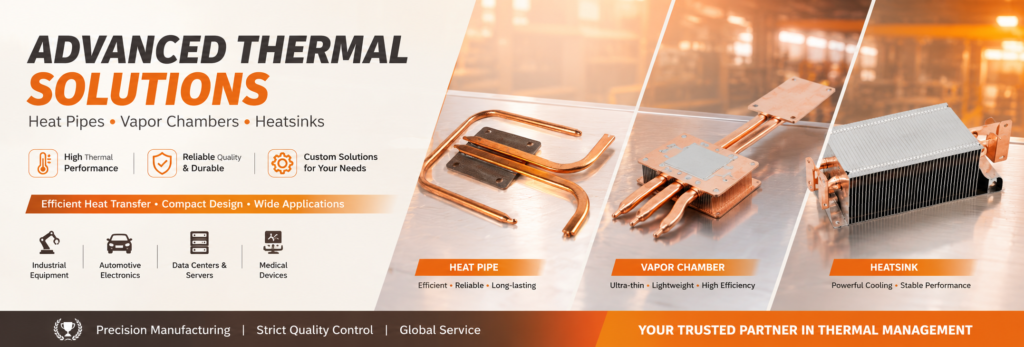
Heat Pipes
Heat pipes transfer heat quickly.
They use phase change technology.

Vapor Chamber
Vapor chambers may be integrated into high-performance heat sinks
They provide better heat spreading.
【Vapor Chamber Production Line】
Common Heat Sink Materials
Material selection affects thermal performance.
Aluminum Heat Sink
Aluminum is widely used.
Advantages include:
- Lightweight
- Low cost
- Good thermal conductivity
- Easy processing
This is why the aluminum heat sinks are able to fit many applications seamlessly.

Copper Heat Sink
Copper provides higher thermal conductivity.
Advantages include:
- Excellent heat transfer
- High thermal performance
Copper is however is a lot heavier, and more expensive.
Aluminum-Copper Hybrid Heat Sink
Others blend aluminum with copper in unique designs.
Therefore, manufacturers achieve balanced performance.
Types of Heat Sinks
There are various applications so the heat sink design will be different.
Extruded Heat Sink
Aluminum extrusion technology is adopted for extruded heat sinks.
Advantages include:
- High production efficiency
- Stable structure
- Cost effectiveness
Skived Fin Heat Sink
Precision cutting technology is applied for the skived fin heat sinks.
Advantages include:
- Thin fins
- High fin density
- Excellent thermal performance
Bonded Fin Heat Sink
Bonded fin heat sinks consist of fins attached to a base plate.
Advantages include:
- Flexible design
- Large cooling area
Zipper Fin Heat Sink
Folded fin structures are used in zipper fin heat sinks.
Advantages include:
- Compact design
- Lightweight construction
Liquid Cooling Heat Sink
Where the Liquid cooling heat sinks use circulation of a coolant.
They provide high cooling capacity.
Comparison between different types of heat sinks: Active Heat Sink and Passive Heat Sink.
Heat sinks are a fairly simple concept that can be split into two categories.
Passive Heat Sink
Natural air flow is the method utilized by passive heat sinks.
Advantages:
- No power consumption
- Silent operation
- High reliability
Applications include:
- Industrial electronics
- LED lighting
Active Heat Sink
Passive heat sinks use no cooling mechanisms while active heat sinks utilize some other form of cooling.
Examples include:
- Fans
- Pumps
Advantages:
- Higher cooling capacity
- Faster heat removal
Applications include:
- CPUs
- GPUs
- Servers
Heat Sink Applications
Heat sinks support many industries.
Computer Cooling
CPUs and, sometimes even more so, GPUs plough out a fair bit of heat.
This is the reason why heat sinks provide stable performance.
LED Lighting
Thermal control is essential for LED systems.
Thus, heat sinks help prolong the service life of LEDs.
Industrial Equipment
Power electronics require reliable cooling.
So basically industrial heat sinks avoid overheating,
Automotive Electronics
Many automotive manufacturers use electronic components in Electric Vehicles.
Heat sinks are a cooling system that assists thermal management.
Data Centers
Servers require advanced cooling solutions.
That is the reason heat sinks manage the higher computing loads.
Heat Sink Manufacturing Process
Thus, a professional heat sink manufacturing process includes multiple stages.
Material Preparation
Manufacturers prepare:
- Aluminum profiles
- Copper materials
Therefore, materials meet production requirements.
Extrusion Process
Provide Aluminum Extruntion heat sinks profiles
CNC Machining
CNC machines create precise dimensions.
Fin Processing
Manufacturers create high-performance fin structures.
Equipment includes:
- Fin machines
- Cutting machines
Assembly Process
Manufacturers combine:
- Base plates
- Fins
- Heat pipes
Heat Sink Production Equipment
Modern manufacturing requires specialized machines.
Important equipment includes:
Heat Sink Production Line
A complete system includes a combination of many processes.
【Heat Sink Manufacturing Line】
Heat Sink Assembly Machine
Used for automated component assembly.
Advantages include:
- High efficiency
- Better consistency
CNC Machining Equipment
Used for precision processing.
Therefore, manufacturers achieve accurate dimensions.
Fin Manufacturing Equipment
For the construction of advanced cooling structures
Therefore, thermal performance improves.
Heat Sink vs Vapor Chamber
Both heat sinks and vapor chambers are responsible for handling heat.
However, they work differently.
Feature | Heat Sink | Vapor Chamber |
Heat Transfer Method | Conduction + convection | Phase change |
Structure | Fins and base | Sealed chamber |
Cost | Lower | Higher |
Maintenance | Low | Low |
Heat Spreading | Good | Excellent |
Application | General cooling | High heat density |
Therefore:
- Heat sinks suit general applications.
- Vapor chambers suit high-performance electronics.
How to Choose a Heat Sink
So for selecting a heat sink, you have to keep in your mind:
Thermal Requirement
Higher heat loads necessitate greater cooling capacities.
Material
Choose between:
- Aluminum
- Copper
- Hybrid materials
Size Limitation
Compact devices require optimized designs.
Manufacturing Method
Different designs require different processes.
Examples:
- Extrusion
- CNC machining
- Skiving
- Bonding
Why Choose Bangwin Machine
Bangwin Machine is the complete solution for thermal manufacturing.
Our equipment includes:
- Heat sink production lines
- Heat sink assembly machines
- Heat pipe production equipment
- Vapor chamber manufacturing systems
Moreover, we provide:
- Customized equipment design
- Production process support
- Technical consulting
- Manufacturing optimization
So, clients get expert warmth manufacturing solutions.
👉 Go to
Home
FAQ
- What is a heat sink?
A heat sink is a thermal component that transfers heat away from electronic devices.
- How does a heat sink work?
A heat sink absorbs heat through conduction and releases it through convection.
- What materials are used for heat sinks?
Most heat sinks use aluminum or copper because of their thermal conductivity.
- Are heat sinks better than vapor chambers?
Heat sinks suit general cooling applications, while vapor chambers suit high heat density applications.
- Can Bangwin Machine provide heat sink production equipment?
Yes. Bangwin Machine provides heat sink production lines and customized thermal manufacturing equipment.
Conclusion
Having an idea what is a heat sink can also help engineers during thermal solutions selection.
Heat sinks provide consistent cooling through effective heat conduction and radiation.
They are used in applications from computers and LEDs to industrial systems and electric vehicles.
As the demand for high-performance electronics increases, heat sink manufacturing technology continues to improve.
Bangwin Machine provides professional heat sink production equipment and one stop thermal manufacturing solution for customers from all over the world.
👉 Check out https://thermalmachinery.com/ to learn more about advanced heat sink manufacturing technologies.